Four Futures for AI and Digital Courts to 2040. An open source tool for scenario planning in civil justice.
The two uncertainties that generate the set
Depth of automation in the justice system (administrative support → pathway redesign → AI-augmented adjudication → automated routine determinations)
Governance + legitimacy capacity (transparent, contestable, auditable, rule-anchored → opaque, fragmented, scandal-prone, politically constrained)
Each scenario below is intentionally differentiated across operating model, authority & accountability, data/procurement, and funding, the levers that determine what courts can actually do.
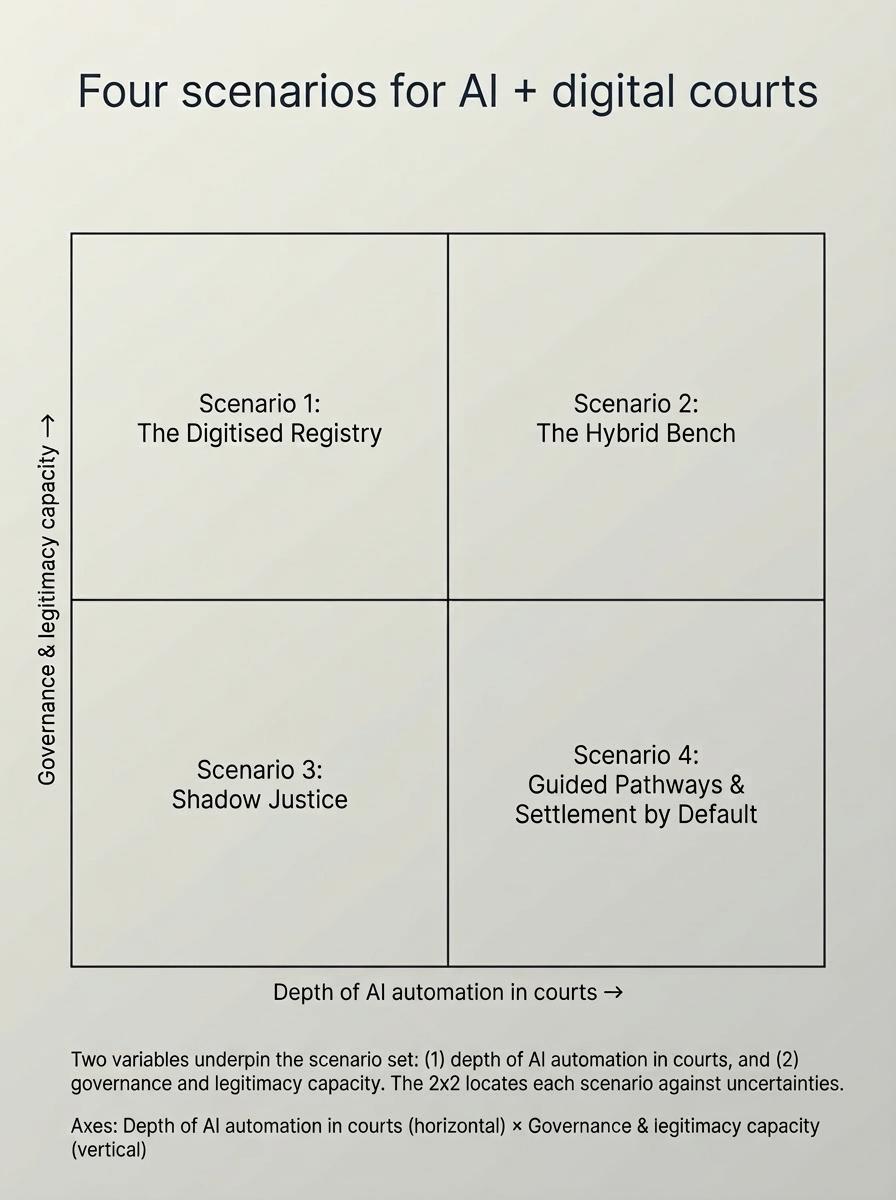
Scenario 1 - The Digitised Registry State
Tagline: “Efficiency rises; the court stays the court.”
2040 snapshot
Courts have modern back offices and better throughput, but the institutional form is largely unchanged. Most disputes still enter through conventional filings and proceed through familiar steps. AI is pervasive in registry operations: classification, extraction, transcription/translation support, scheduling optimisation, backlog analytics, but carefully avoided in anything that looks like adjudication.
Operating model
Digital filing and registry automation are mature.
Hearing-heavy processes persist; many steps remain lawyer-shaped.
Improvements show up as shorter queues, fewer rejected filings, and better caseflow visibility.
Authority & accountability
Courts insist AI is “administrative only”.
The legitimacy risk sits in hidden outcome-shaping admin: routing, listing priority, default timeframes, and staff reliance on flags.
Disclosure to parties is minimal because AI is framed as operational plumbing.
Data, procurement, control
Vendor stacks dominate (case management + add-ons).
Logging exists but is operational, not designed for legal contestability.
Data quality becomes a strategic constraint: automation amplifies inconsistencies.
Funding pattern
Financed through incremental budgets and procurement cycles; benefits framed as productivity.
Early signals
Large contracts for transcription/translation, triage-by-routing, scheduling tools.
Strategy documents emphasise “efficiency and backlog” more than pathway redesign.
AI policy remains IT/procurement-led rather than rules-led.
Planning questions
Which “administrative” decisions require contestability because they shape outcomes?
How do you stop registry automation becoming de facto merits triage?
Scenario 2 - Guided Pathways and Settlement Infrastructure
Tagline: “The front door becomes the justice system.”
2040 snapshot
The biggest transformation happens before court. Most low-value civil disputes move through guided pathways: eligibility screening, evidence checklists, structured negotiation, early neutral evaluation, and standard-form settlements. Courts still matter, but function more as an escalation layer and legitimacy anchor.
Operating model
A unified public-facing portal becomes the primary interface for self-represented litigants.
Disputes are routed into proportional pathways (information → negotiation → facilitated settlement → determination).
Formal proceedings are fewer; the system is “pathway-first”.
Authority & accountability
Legitimacy hinges on choice architecture: defaults, nudges, time pressure, and friction to escalate.
Strong safeguards exist for vulnerability (family violence/coercion, language, disability, urgency).
Disclosure is explicit: users know when they are interacting with AI, and what it can/can’t do.
Data, procurement, control
Government-owned design standards for pathways (what must be disclosed, logged, reviewable).
Interoperability improves—identity, payments, evidence formats—so users aren’t trapped in vendor ecosystems.
Audit focuses on distributional effects (who settles, who escalates, who drops out).
Funding pattern
Investment justified as demand management + access: “resolve earlier, escalate less”.
Ongoing funding tied to measurable reductions in defective filings and unrepresented burden.
Early signals
National/statewide portal programs with escalation logic and vulnerability triage.
KPIs shift from “cases disposed” to “disputes resolved proportionately”.
Increased scrutiny of nudging, fairness, and withdrawal/appeal rights.
Planning questions
How do you prove procedural fairness in a system designed to avoid hearings?
What is the minimum viable escalation right that preserves legitimacy?
Scenario 3 - The Hybrid Bench with Auditable AI
Tagline: “Judges remain accountable; AI becomes a governed co-pilot.”
2040 snapshot
AI is embedded into judicial workflow under explicit governance. Human decision-makers remain responsible, but AI handles structured synthesis at scale: summarising evidence, generating issues lists, drafting parts of reasons and orders, and running consistency checks—within secure court environments. Routine matters move through fast lanes with strong review rights.
Operating model
Born-digital procedures spread in specific jurisdictions/streams (small claims, administrative review, high-volume civil).
Hearings become more focused: the record is clearer earlier, and issues are narrowed.
Decision-making is faster and more consistent where the record is well-structured.
Authority & accountability
This is the “high legitimacy” AI future:
Audit trails are designed for contestability (what the tool saw, what it produced, who approved).
Citation-locked drafting: the system cannot invent; it must anchor to the record.
Update governance: model changes are treated like procedural rule changes—tested, approved, logged.
Disclosure is calibrated: where AI materially shapes reasoning or routing, it is discoverable and reviewable.
Data, procurement, control
Courts insist on: logging, audit access, portability, and incident response.
Court-controlled secure environments become standard (limiting data leakage and vendor dependency).
Interoperability and data standards advance because AI requires structured records to be safe.
Funding pattern
Funded as “capability infrastructure”: invest now to avoid collapse under demand and complexity.
Savings realised via reduced judicial overload and fewer adjournments/rework.
Early signals
Formal policy frameworks for AI in adjudicative contexts, not just admin.
Standing evaluation teams; published performance and drift monitoring.
Courts negotiate hard procurement terms (audit, update control, exit options).
Planning questions
What minimum governance makes AI drafting compatible with judicial independence?
How do appeal records treat AI-assisted reasoning without turning appeals into “model trials”?
Scenario 4 - Backlash, Fragmentation, and Shadow Justice
Tagline: “AI accelerates—outside the courts.”
2040 snapshot
One or more high-profile failures (bias scandal, fabricated reasoning, data breach, wrongful automated filtering) triggers retrenchment. Courts restrict visible AI use, governance becomes politicised, and reform stalls. Meanwhile, private actors expand dispute handling upstream: platforms, insurers, banks, landlords, employers, and utilities build AI resolution into customer workflows. Courts become an enforcement backstop and crisis resolver.
Operating model
Public courts remain congested and process-heavy for contested matters.
A parallel ecosystem resolves many disputes privately or semi-privately.
Individuals increasingly experience “justice” through platform processes and contract terms.
Authority & accountability
The legitimacy problem shifts: not “AI in courts” but “justice functions without public safeguards.”
Contestability is weak outside courts; decisions are fast but opaque.
Courts face pressure to enforce private outcomes at scale (default judgments, automated compliance, arbitration-like determinations).
Data, procurement, control
Vendor lock-in and fragmented systems prevent coherent public oversight.
Data governance is inconsistent; audit access is contested or absent.
Private standards evolve faster than public ones, setting de facto norms.
Funding pattern
Fiscal constraint + political risk aversion drive underinvestment in public reform.
Private sector funds capability because it lowers transaction costs and reduces customer handling.
Early signals
Moratoria or statutory constraints after incidents.
Rapid growth in private ODR clauses and automated enforcement.
Increased judicial commentary and appeals about opaque private processes.
Planning questions
What is the state’s posture on enforcement of private determinations?
How do you regulate “justice functions” performed by platforms without undermining access?
An additional layer to stress-test all four scenarios
Any of these can occur in any scenario, but they matter differently depending on governance capacity:
Major cyber incident affecting court records or identity systems
Model collapse or vendor failure mid-stream
Constitutional / human rights litigation about automated influence on decisions
Severe austerity or sudden demand shock (economic downturn; mass claims)
Cross-border data restrictions that disrupt cloud procurement
Use these as stressors in workshops to test resilience, not just direction.
