Selected Work
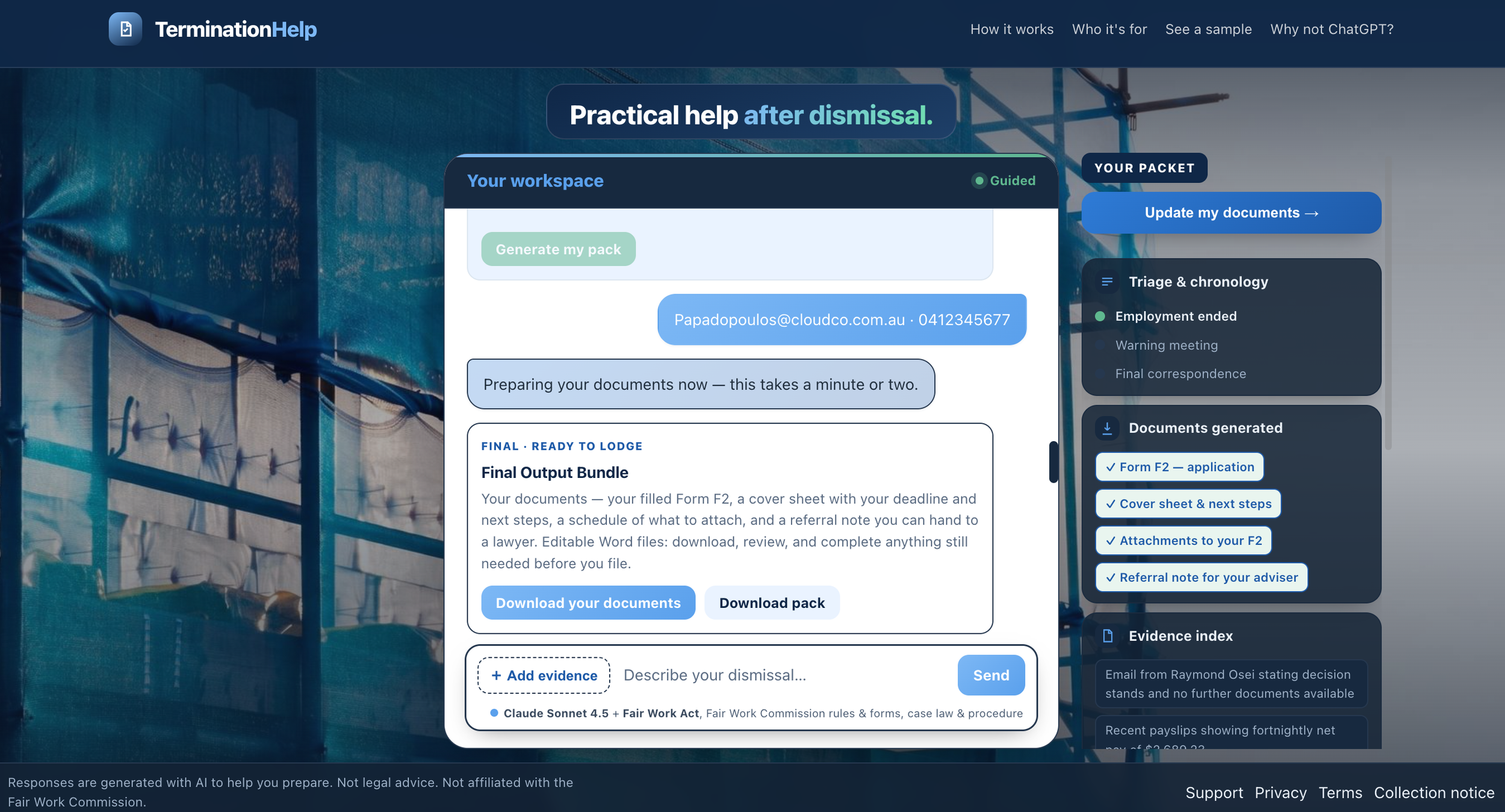
Termination Help is an Australian AI-guided preparation service for people considering an unfair-dismissal application. It helps users explain what happened, organise relevant documents, identify key dates and missing information, and produce editable preparation materials, including a draft Form F2, statement, chronology and evidence index. The service uses deterministic deadline calculations and controlled document-generation workflows, while deliberately avoiding legal advice, merits assessments, outcome predictions or automated filing. It is designed to improve access, preparation quality and referral pathways not replace the Fair Work Commission, unions, community legal centres or lawyers.
Quality is achieved through a structured, evidence-grounded process rather than unrestricted AI drafting. The system extracts facts from the user’s account and documents, attributes them to their sources, calculates deadlines using deterministic rules, and assembles outputs through controlled templates and pipelines. Automated checks prevent unsupported legal conclusions and outcome predictions, require legal propositions to be grounded in approved authoritative sources, and keep privileged or “without prejudice” material separate. The resulting documents are clearly presented as editable drafts for the user and, where appropriate, a qualified professional to review before use.
A guided employment law pathway for Unfair Dismissal and General Protections claims in the Fair Work Commission
Test Packs
Download a test pack, and visit TerminationHelp.com.au to upload your documents, and test this tool.
JusticeDataStudio.com
Research grade synthetic corpus, fully customisable
The Synthetic Justice Data Studio produces research-grade synthetic matter corpus designed for justice technology, digital court, and legal AI testing. It combines a canonical reference matter with configurable distributions of ordinary and edge-case files so teams can evaluate drafting engines, case-management systems, workflow automation, analytics pipelines, and AI models under conditions that more closely resemble live operational environments.
The dataset outputs include richly structured court and party metadata, pleadings-level fact patterns, event-based chronologies, procedural schedules derived from commencement dates, and machine-readable fields for document assembly and system validation. It also supports separately indexed outlier matters for robustness testing, allowing teams to vary the proportion of atypical files, stress-test failure modes, and verify expected behaviour against known scenarios across different procedural settings and jurisdictional profiles.
Matters can be generated to reflect the margin of different jurisdictions, with configurable court labels, procedural assumptions, and filing conventions layered onto a consistent core schema. This makes the pack suitable for product demonstrations, QA environments, model evaluation, regression testing, and comparative benchmarking where realistic but non-live justice data is needed.
The Justice Data Studio is the only commercial vendor of justice-tech testing and evaluation case files.
Existing legal datasets and benchmarks tend to focus on case retrieval, citation analysis, or general legal tasks, whereas this pack is designed for operational testing of justice workflows, AI deployment, filings, and system behaviour.
To view sample data packs, or learn more, follow the link below.
Brandeis-TRP.com
Guardrails for deployment of AI in Courts
Brandeis-TRP is an operational governance platform for courts, tribunals and other justice institutions.
It has been designed to allow institutions to maintain essential public confidence and trust, during AI deployment and ongoing AI operation.
Brandeis-TRP is a governance tool, that delivers 100% of the governance requirements and recommendations emanating from regulators, law reform commissions and think-tanks.
The tool is a governance layer that sits above any and all AI tools deployed in the workflow of courts and tribunals. It exists to verify that court deployed AI performs accurately, protects sensitive data, or complies with judicial principles.
Brandeis-TRP provides continuous, independent oversight: monitoring accuracy, enforcing data sovereignty, and generating contestation-ready records.
With good governance systems in place, courts can begin to pilot AI with confidence, scale at pace and realise the potential of AI.
Named for the justice who declared sunlight the best disinfectant, Brandeis-TRP lights up the inputs and outputs of AI systems, tracks testing, bias, and compliance.
Click the link below to learn more and view the TRP dashboards.
Governance Frameworks
Evidence-based frameworks and published research designed to help courts, legal institutions, and policymakers navigate AI adoption without sacrificing accountability, legitimacy, or public trust. Each framework is grounded in research infrastructure and oriented toward the institutional design questions practitioners actually face.
Distributional Analytics — distributional analysis reveals who the justice system is actually serving; rather than how many and how quickly (throughput analytics). See Beyond Disposal Rates: Why Distributional Analytics Will Define the Legitimacy of Digital Courts
Taxonomy of AI Tools — a structured classification of AI tools deployed in court and legal institutional contexts, by function, risk profile, and proximity to official output; See AI arrives in the Courts
Authority Exercise Test — for measuring how much public authority an AI tool exercises in practice, and what governance obligations follow
Proportional Governance Frameworks — governance requirements calibrated to the authority-exercise profile of each tool category
AI Procurement Framework for Justice Sector Actors — a risk-aligned procurement methodology for courts and legal institutions evaluating AI tools
Born-Digital Courts and Process Proportionality — design principles and evidence drawn from digitally native court models, examining the structural advantages of governance-first institutional design
The Architecture of Trust — institutional design as the hidden infrastructure of the AI era; why legitimacy, governance, and accountability must be built in before policy is debated
Justice Data Standard v2.2 Commercial Guide
Courts and tribunals remain among the least digitally mature major public institutions. While finance, health, trade and statistics have all undergone systematic digital transformation underpinned by shared data standards, justice systems still rely on fragmented, vendor‑specific schemas and manual data exchange. The result is non‑interoperable case‑management systems, limited visibility of performance and access‑to‑justice outcomes, and significant barriers to responsible deployment of AI and analytics across the justice lifecycle.
JusticeData v2.2 is a modular data standard for courts and tribunals. It specifies how core justice data (cases, parties and identity, documents and evidence, hearings and procedure, decisions and reasons, fees and costs) is structured, exchanged and secured across systems and jurisdictions. The standard comprises ten interlocking modules that operate as a single interoperable framework, spanning case metadata, parties, documents, hearings, decisions, security, integration, analytics, governance and ethics.
For early adopters, the Minimum Viable Justice Data (MVJD) Profile defines a lean conformance slice of the standard focused on case metadata, parties and baseline security/privacy. It is designed to be implementable within existing case‑management systems while still delivering immediate interoperability and analytics gains. The MVP profile also underpins the Justice Data Test Pack, allowing vendors and court IT teams to exercise real systems against realistic but non‑live matters before moving toward full‑module implementation.
JusticeData v2.2 is technology‑neutral and jurisdiction‑agnostic. It is designed to guide and support technology developers, vendors and justice IT teams, and can be adopted in full by public institutions and suppliers without prescribing substantive law or local procedure. Courts can retain full control over legal rules and workflows, while converging on a common data layer that makes digital transformation, interoperability and AI governance tractable.

AI-Powered Products Under Development
Commercial governance technology products designed to close the gap between rapid AI adoption and the accountability standards justice institutions require.
Products are built directly from the evidence base in the research infrastructure — structured datasets and governance frameworks informing tools that work at the point where AI enters justice institutions.
Governance tools that sit between AI tool deployment and official institutional outputs, enabling certification, chain-of-custody, and accountability at the point where AI enters official records
Justice sector AI governance layer applicable across the full range of AI tools deployed within a court or legal institution
Born-digital court platforms, with governance as a critical feature of the architecture
Sector Expertise Law & Justice
Technology companies and legal tech players building into justice markets face a distinct challenge: institutions are risk-averse by design, legitimacy-constrained in ways that don't appear in standard market analysis, and structurally resistant to procurement pathways that work elsewhere.
Nicolas supports technology and legal technology players as a sector expert — providing insight on justice sector institutions, legitimacy constraints, governance design integration, access to justice principles, fairness, transparency & bias, and proportionality to improve product alignment and unlock market opportunity.
Market Insights
Global, structured datasets, updated weekly, produce game-changing market insights for justice tech developers, vendors, regulators, systems integrators, courts, police, parole, corrections, law firms, insurers and other justice sector and justice sector adjacent actors.
The datasets are analysed by AI-enabled tools to identify market patterns, anomalies, implications, risks and opportunities bespoke to the subscriber.
Data Insight #25: Together, ‘Data rights + data protection” emerge as the de facto constraint layer for AI adoption in justice, shaping what can be built, bought, and deployed.
Model performance may take a back seat as procurement and design choices will increasingly be focussed on privacy/data protection, contestability, and security requirements.
Data Insight #26: Low-Risk, High-Throughput: Courts are clustering AI adoption around guided e-forms, rule enforcement, and filing defect reduction. The pattern suggests institutional risk appetite is shaped less by capability than by proximity to official output and contested decision-making.
Data Insight #102: Adoption controversy is converging on one strategic question:
“Is AI responsible for part of a decision that affects rights, and can the public meaningfully challenge it?”
This is the one of the key adoption issues driving transparency litigation and governance demands.
Boards
Boards confronting AI governance obligations rarely have directors who bring both the institutional design depth and the sector-specific experience to support governance decision-making.
As regulatory expectations rise and stakeholder scrutiny of AI risk intensifies, the gap between nominal and genuine board-level AI governance capability is widening.
With more than two decades of experience as a lawyer and senior partner in a global law firm, sustainability and responsible business professional, board member and board chair, Nicolas is a trusted advisor to and member of boards navigating the social impact risk created by AI deployment, reputation risk, AI regulation, evolving stakeholder expectations, and responsible business practices.

“System-level thinking combined with a strategic approach to innovation.”
Board Chairperson, Global Professional Services Firm.