Four Futures for the Community Legal Sector
March, 2026
This article explores four future scenarios for AI-enabled digital justice in Australia. It examines AI adoption trends and justice platform growth across Australia, New Zealand, Canada, and the United Kingdom to map where the justice system is heading and considers the impact for CLCs and other legal service providers. Several conclusions emerge from the analysis, including:
The case for greater sector-level coalition building, integration and collective strategic planning has never been stronger.
The time to design the architecture of the future justice system is right now.
The organisations that engage collectively, deliberately and soon, will have far more influence over the outcome than those that wait until the design is finished to provide feedback.
A Framework for Reading the Field
Two structural forces will reshape justice systems over the next decade: the rate of AI adoption across the justice sector, and the degree of platform concentration (the extent to which a small number of dominant actors control the infrastructure of legal practice).
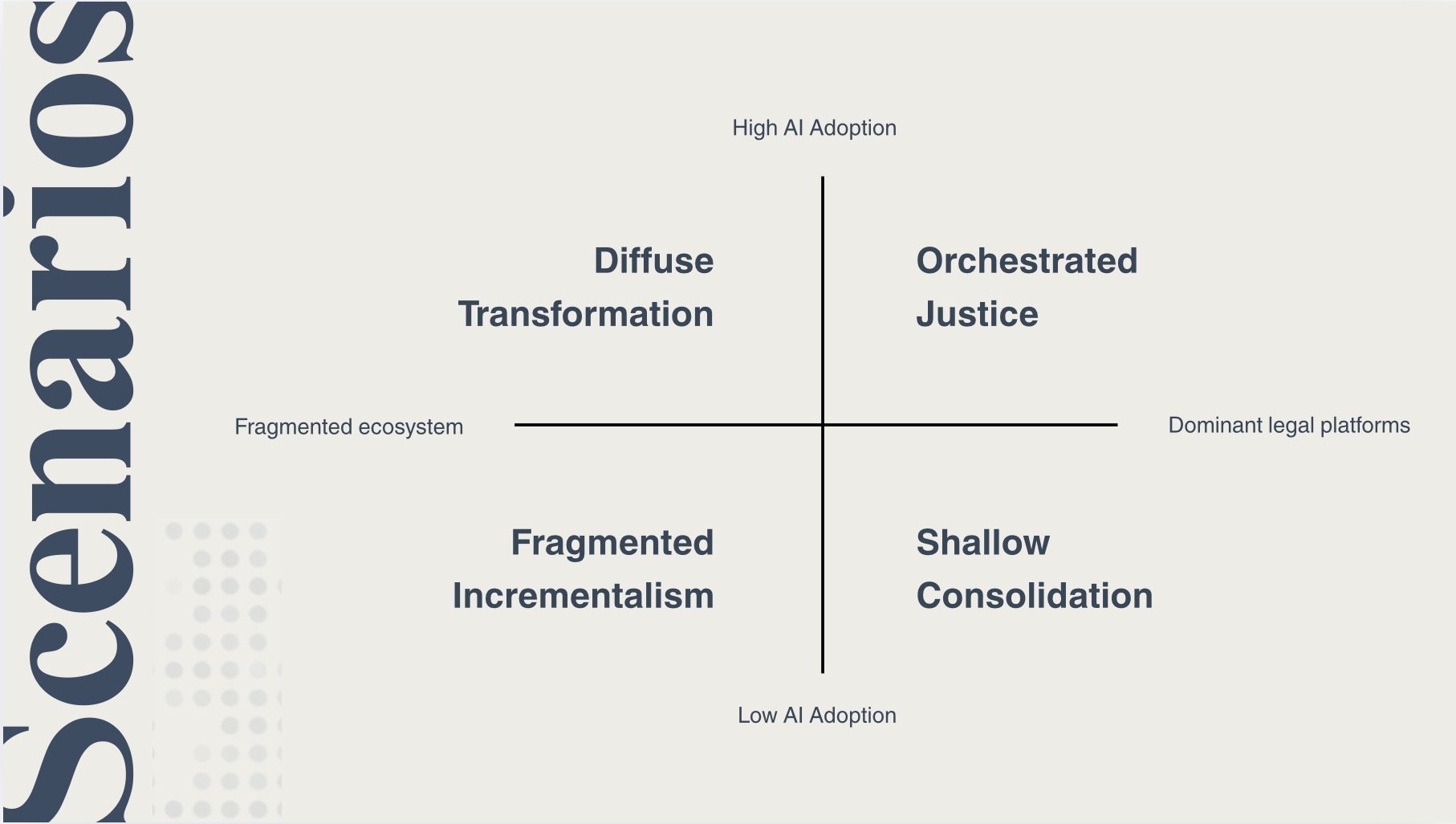
Four futures for the Justice Sector. An open-source tool for Justice Sector actors to engage in scenario-based strategic planning.
Fragmented Incrementalism — Low AI adoption, fragmented ecosystem. Change is slow and path-dependent. AI remains mostly experimental. CLCs retain autonomy but risk falling progressively further behind better-resourced actors who are moving faster.
Diffuse Transformation — High AI adoption, fragmented ecosystem. AI tools proliferate rapidly but without coordination. Capability spreads unevenly. CLCs retain high levels of independence but are isolated, with fragmented data, limited shared infrastructure and uneven access to AI-enabled tools, struggling to scale or influence the system.
Shallow Consolidation — Low AI adoption, dominant platforms. Platforms capture the infrastructure layer before AI capability arrives. Incumbents entrench their structural advantage. By the time AI lands at scale, the architecture has already been built around the interests of those incumbents.
Orchestrated Justice — High AI adoption, dominant platforms. AI integrates into legal workflows at scale through a small number of dominant actors. Efficiency improves, but control concentrates. CLCs must choose: federate and trade some independence for shared infrastructure and influence, or operate on the margins of a system shaped by others.
None of these futures is inevitable. Which one any jurisdiction moves toward depends significantly on what the sector does over the next two to three years.
Four Jurisdictions, Four Trajectories
New Zealand: Shallow Consolidation
New Zealand illustrates Shallow Consolidation. Court and legal services infrastructure is being organised around centralised platforms and single-vendor procurement, while AI deployment remains limited and largely experimental. Institutional incumbents (courts, government agencies, large firms) are accumulating structural power before the transformative technology has arrived.
Community law centres in New Zealand operate primarily as contracted service providers to the Ministry of Justice, which sets performance standards, conducts audits, and controls funding. They have not historically held significant influence over justice system design or governance. The risk of Shallow Consolidation for the sector is the loss of the opportunity to participate meaningfully in the future. As platform architecture is set through procurement decisions and funding structures, the window to be included as a design partner closes. When AI capability does arrive at scale, it will land in a system already shaped around incumbents, and community legal organisations will find themselves negotiating for access to infrastructure built without them.
The strategic window in Shallow Consolidation is to act before AI arrives, to challenge incumbent authority on performance grounds, establish access obligations, and build governance frameworks while the gap between platform power and actual justice outcomes is still visible. In New Zealand, that window is open, but narrowing.
Canada: Diffuse Transformation
Canada sits squarely in Diffuse Transformation, and is arguably the clearest illustration of that quadrant in the common law world.
Roughly 80% of Canadian law firms with more than 20 lawyers are piloting or researching AI tools, but only 7% have fully implemented them. That is the Diffuse Transformation signature precisely: widespread exploratory adoption without coordination or depth. Hallucinated citations have appeared across courts, tribunals, and boards in multiple provinces, with each jurisdiction developing its own reactive response. Canada’s statutory framework regulating AI remains largely underdeveloped, with courts and regulators frequently looking to international jurisdictions for guidance.
Canada also provides the most instructive cautionary example for jurisdictions considering born-digital Courts. British Columbia’s Civil Resolution Tribunal (the CRT) was genuinely innovative: a born-digital, online-first dispute resolution platform that proved the model was viable and achieved real access-to-justice gains for users with low-value civil claims. But growth has been constrained by the absence of a sustainable financial model design to grow and maintain it. The platform was built; but platform operators were not created alongside it. Innovation without institutional and financial sustainability is one of the defining failure modes of Diffuse Transformation. The CRT stands as a lesson that technology design and organisational design must advance together.
Australia: Fragmented Incrementalism, With Emerging Gravitational Pull
Australia currently sits in Fragmented Incrementalism, though with emerging forces that could shift its trajectory.
The evidence: Each court jurisdiction is making its own rules on AI. NSW courts have taken among the strictest stances in the common law world; Victoria has been among the most consultative; Queensland has its own guidelines. Hallucinated citations have appeared in the Victorian Supreme Court and the Federal Circuit and Family Court — and the response has been reactive and jurisdiction-by-jurisdiction. This is slow, path-dependent change across a dispersed ecosystem.
But centralising forces are emerging. The Victorian Law Reform Commission tabled Australia’s first law reform inquiry into AI in courts in February 2026, containing thirty recommendations, a principles-based approach, with genuine engagement with access-to-justice concerns. The federal government announced an Australian AI Safety Institute in November 2025. These are gravitational signals and early indications of coordination pressure that could accelerate Australia toward either Diffuse Transformation or, if commercial platforms fill the vacuum first, toward Shallow Consolidation and then Orchestrated Justice without safeguards in place.
For the community legal sector in Australia, the current position in Fragmented Incrementalism is not comfortable but it is workable and the governance window is open, policy contributions are still possible, and no dominant platform has yet captured the infrastructure layer. The strategic imperative is to use that window deliberately before external forces determine the trajectory.
The United Kingdom: Orchestrated Justice
The United Kingdom has moved decisively into Orchestrated Justice through deliberate government action at pace.
The Ministry of Justice published a formal AI Action Plan in April 2025, setting out a three-year “Scan, Pilot, Scale” roadmap across courts, prisons, and legal services. Record public funding was committed for 2026–27. In September 2025, a Google-backed AI platform acquired a law firm, described as a legal industry first, in exactly the kind of vertical integration that defines Orchestrated Justice in practice. By October 2025, a judge had used AI in a published decision for the first time, with updated judicial guidance issued the same month.
The UK is now the most advanced real-world test of whether Orchestrated Justice can be made equitable. The deployment layer is moving fast; the governance layer is trying to keep pace. The practical lesson for Australia and Canada is clear: the governance interventions that matter most (algorithmic auditing rights, outcome data access, digital inclusion obligations) are most powerful when engaged while AI is being embedded, not after.
Five Strategic Plays That Hold Across All Futures
The following strategic plays generate value regardless of which future materialises. They are compounding strategies, that are most powerful when executed together.
Claim the governance layer. Co-own standards and accountability frameworks in coalition with regulators and professional bodies. Perform auditing and accountability functions above the platform layer. No single CLC can credibly claim this position alone, it requires a sector voice, which is itself the argument for collective action.
Build and lead a coalition. CLCs, legal aid bodies, pro bono providers, and legal technology partners designing and building AI-assisted intake, triage, and document automation together creates shared infrastructure no individual organisation could sustain, and a negotiating force that platforms and government agencies cannot ignore. The coalition is not just an efficiency play; it is a power play.
Treat data as a strategic asset. In every scenario, data does essential work: it builds the evidence base for changing trajectory, exposes systemic bias, identifies capability gaps, and demonstrates the need for guardrails. Isolated data held by individual CLCs has limited power. Aggregated, sector-wide data, negotiated across platforms, government agencies, and research partners will generate substantial data to drive impact.
Realign client targeting to digital exclusion. The clients most at risk are shifting. Financial incapacity remains real, but digital incapacity (the inability to identify and navigate AI-mediated systems) is the emerging and underserved frontier. CLC and Legal Aid eligibility criteria, intake processes, service design and funding submissions need to reflect this now, before the gap widens further.
Build shared AI capability. Internal AI capability extended through the coalition with support from pro bono and technology partners is the critical prerequisite for all other plays. Building it in isolation across individual CLCs is inefficient and produces the fragmented outcome the sector needs to avoid. The play is collective infrastructure, not parallel individual innovation and investment.
The Case for Sector-Level Action
The four country examples reveal a consistent pattern: the community legal sector’s ability to participate meaningfully in justice system design diminishes as platform concentration increases, regardless of whether AI has arrived yet. The organisations that shape the governance framework before consolidation locks it in are those that act collectively and early.
This is the moment for continued and expanded sector-level coordination, further strides toward integration and federation - especially the deployment of common case management platforms, a single federated legal practice, shared document management and shared workflow tools, which represent the enabling architecture for the deployment of AI-tools. This will require focussed consultation, engagement with CLC boards, strong and visionary leadership, the exertion of greater pressure by CLC funders, and a clear and compelling sector-level national strategy that aligns CLCs, legal aid, peak bodies around a shared response to a shared challenge. The forces now reshaping the justice system operate at a scale that individual organisations cannot match. A single CLC cannot negotiate meaningful data access or accountability obligations from a dominant platform. A coordinated sector voice can.
For CLC boards and leadership teams, three actions stand out. Check your strategic plan against these scenarios. Engage with governance and policy development. Policy submissions framed around access-to-justice as a design constraint will land with greater force than those framing it as a service delivery issue.
The Bigger Question
Infrastructure has always carried obligations. Utilities serve all customers. Telecommunications networks provide access at regulated prices. The justice system has always been understood as something more fundamental. Namely, the institutional foundation of a fair society. When the platform layer of the justice sector is built, who will build it, and what obligations should apply?
AI is forcing that question into sharp relief.
The Justice system platform layer that will come into existence in Australia, New Zealand, Canada, and the United Kingdom over the coming years, will determine who can access the justice system and on what terms, and with what protections.
Community legal centres and legal aid organisations have two things no platform can replicate: deep trust relationships with the people most at risk of being left behind, and the legitimacy to challenge the system when it fails them.
Nicolas Patrick is a justice system reform strategist and thought leader focused on AI governance, institutional design, and access to justice. He has more than two decades of experience as a leader in the community legal sector, and the global pro bono sector. He is currently studying AI for business transformation at Oxford Saïd Business School and writes at nicolaspatrick.me.
