
Work Me Out.
Curious to see Termination Help in action?
Download a synthetic test file today, containing Claimant pre-commencement material.
Use those documents to see how Termination Help performs.
Click below to download, and be sure to share your feedback.
FAQs for community legal centres, unions, legal aid, and other referrers.
What is Termination Help?
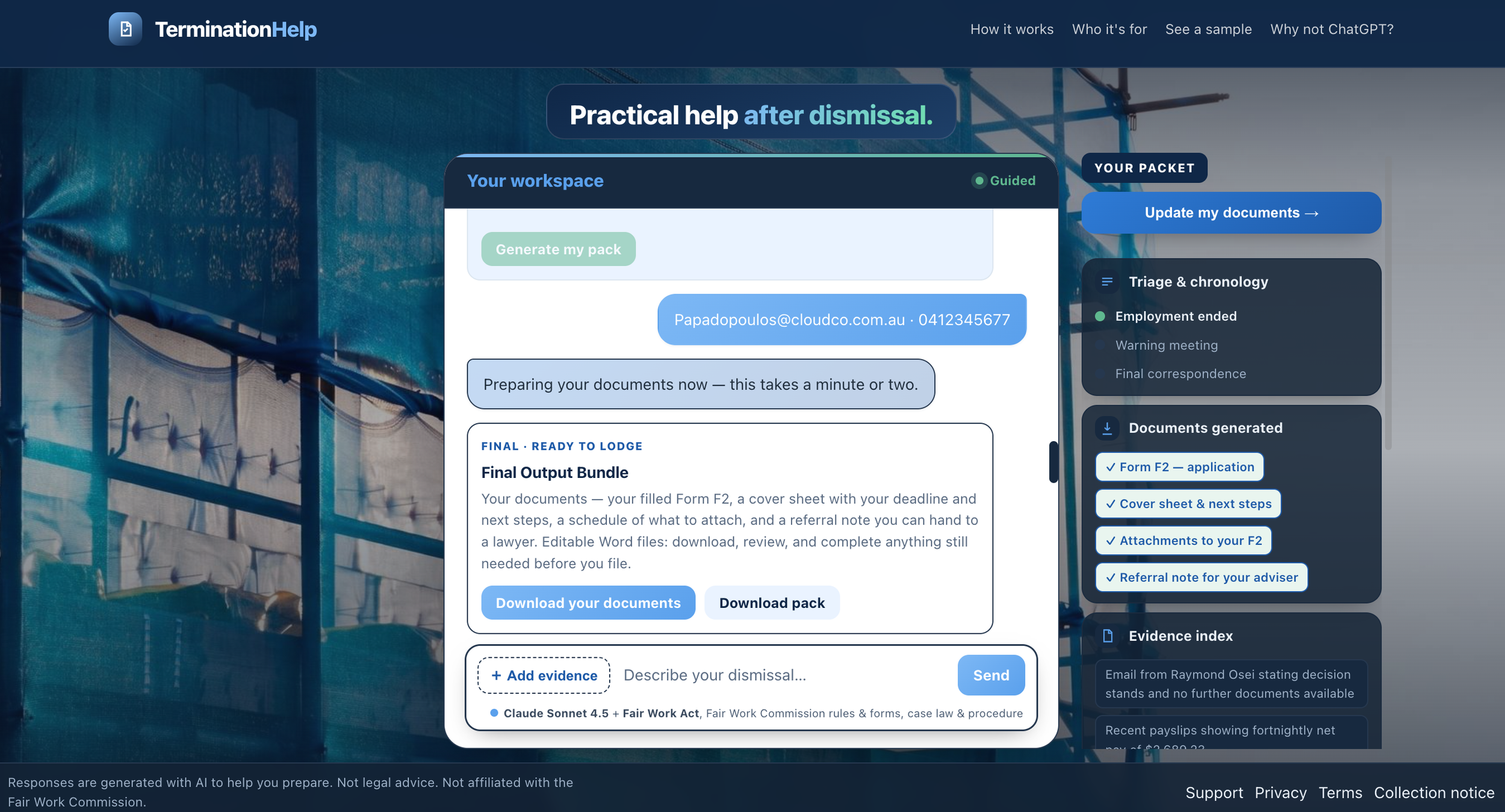
Termination Help is an Australian digital service that helps people organise their information and prepare working documents following dismissal from employment.
The service uses a guided conversation to collect the person’s account, relevant dates and supporting documents. It then turns that information into structured preparation materials for a potential Fair Work Commission unfair-dismissal application.
Who is the service designed for?
The tool was built for individuals who cannot afford, or will not engage, the services of a lawyer following termination of their employment. The tool was designed following media reports of defective or poor quality claims being filed in the Fair Work Commission due to growing reliance on General Purpose AI Tools, such as ChatGPT.
The tool can assist people who:
have been dismissed from employment in Australia;
may be considering an unfair-dismissal application;
need help organising their facts and documents;
are working within a short timeframe; or
cannot immediately obtain legal advice.
It may also help a person prepare more effectively before speaking with a union, community legal centre or lawyer.
What does the user receive?
Depending on the information available, the preparation pack may include:
a draft Fair Work Commission Form F2 (or other appropriate form)
a first-person applicant statement;
a cover sheet showing key dates;
a dated chronology;
an evidence index;
a missing-information checklist; and
practical next-step and referral information.
The documents are editable working drafts. The user must review them and decide whether and how to use them.
Does TerminationHelp provide legal advice?
No. Termination Help provides guided information and document-preparation support.
It does not:
provide legal representation
assess whether a case is strong or weak;
predict whether an application will succeed;
estimate compensation;
negotiate with an employer; or
lodge an application for the user.
Where complexity is flagged, or legal judgement is otherwise required, the service encourages the user to seek assistance from a union, community legal centre, Legal Aid service or private lawyer.
Does it replace unions, CLCs or lawyers?
No. It is designed to complement, not replace, available legal assistance.
Termination Help can support the early preparation work that often occurs before substantive advice is provided. The legal service provider may supply new clients with a link, and request they upload docs and answer any questions about the events leading up to the termination of their employment. The user would then send the electronic output to the lawyer to review in (or prior to) the first meeting.
A client may then arrive at a referral appointment with a clearer chronology, organised documents, identified information gaps and editable drafts of FWC forms.
Any individuals who are not eligible for free legal assistance can also be provided with access to this tool.
Does the service decide whether someone is eligible for Legal Aid or a CLC service?
No. Eligibility, matter coverage, means tests, merits tests, catchments and service availability differ between providers.
For users that come directly to TerminationHelp, referrals are provided in instances of complexity and vulnerability,
Termination Help may identify that a person is vulnerable, and/or has a matter that raises complex issues, and meets certain criteria for free legal assistance In that case a user will receive a referral to an appropriate service. The relevant organisation makes the final decision about whether and what assistance it can provide.
How does it deal with the 21-day timeframe?
The user is asked for the date their dismissal took effect. A deterministic calculator, not a generative AI estimate, then calculates the apparent 21-day filing deadline and displays the time remaining.
The calculation is intended to help the user act promptly, but it is not a legal determination. A person who may be outside the usual timeframe is not automatically rejected and may be directed to seek urgent legal assistance.
What happens if the person may have a different type of claim?
Dismissal can raise issues beyond unfair dismissal, including general protections, discrimination, underpayment, workplace injury, contractual or other employment-law issues.
Termination Help does not attempt to resolve every possible legal pathway. The tool might for example, generate a General Protections claim form, refer certain aspects of matter to other decision makers or alternate jurisdictions eg Fair Work Ombudsman, Anti-Slavery Australia, Australian Human Rights Commission.
Where the circumstances appear complex or outside the supported preparation pathway, the service can flag the need for professional review and include appropriate next-step information.
Will the service reject a person because their matter is complex?
Complexity does not automatically prevent the person from organising their facts and documents.
The service can continue helping with preparation while identifying issues that may require specialist advice. It does not attempt to make definitive legal findings about those issues.
How does document handling work?
Users may provide relevant materials such as:
termination correspondence;
warnings or performance documents;
emails and text messages;
employment contracts;
payslips;
policies;
medical or capacity-related correspondence; and
other records relevant to what happened.
The service uses those documents to help identify facts, dates and possible information gaps. Users should provide only material they are authorised to share.
All documents uploaded are securely stored on shore in Australia in compliance with all data protection and privacy requirements. No uploaded documents are retained by or used to train large language models.
How is privileged or settlement material handled?
The service is designed to identify material that may be privileged or marked “without prejudice” and keep it separate from ordinary factual processing. This ensures, to the fullest extent possible, and in line with the current legal requirements, that privilege is not waived by the user uploading a privileged document.
Users should still exercise care when uploading sensitive documents and seek legal advice if they are unsure whether material should be disclosed or used.
Does Termination Help use AI?
Yes. AI assists with the guided conversation and the organisation of information.
There are three AI-enabled modules active in Termination Help. AI assistant 1 supports the user chat interface, and ask questions to discover all facts and documents relevant to the claim. AI assistant 2 creates the bundle using the facts discovered by Assistant 1. AI assistant 3 is a QA agent, which checks the quality of the output, and carries out fine-tuning where required to improve or revise output.
However, important controls are separated from the conversational AI. For example:
the apparent filing deadline is calculated using deterministic rules;
generated documents are assembled through a controlled pipeline;
the system is restricted from predicting outcomes or compensation;
legal propositions must be grounded in approved sources; and
outputs are presented as drafts rather than final legal conclusions.
The service clearly discloses its use of AI.
Are the documents reviewed by a lawyer?
No.
Documents uploaded by a user are not reviewed.
Documents generated by the tool are not reviewed.
The tool has been extensively tested by lawyers prior to launch.
A user may choose to have documents reviewed by a lawyer or a legal assistance provider, or referral partner under its own intake and service arrangements, but Termination Help does not represent that its standard output has been reviewed or approved by a lawyer.
Is Termination Help affiliated with the Fair Work Commission?
No. Termination Help is an independent service. It is not part of, endorsed by or affiliated with the Fair Work Commission or any government agency.
Who controls Termination Help?
TerminationHelp is owned by Justice Futures Pty Limited, which in turn is owned and controlled by Nicolas Patrick.
Nicolas has worked in the Access to Justice sector for more than 25 years in Australia and internationally, in global law firms and community legal centres.
Nicolas has founded several innovative legal services designed to support accessibility and promote better justice outcomes.
Can a CLC or union access a user’s information?
Not automatically.
Information or documents can only be shared with a referral partner by the user themselves.
Does the service lodge the application?
No. Nothing is filed automatically.
The user remains responsible for reviewing the documents, completing any missing information, obtaining advice where needed and lodging an application if they choose to proceed.
What are the benefits for referral partners?
Termination Help may deliver efficiency dividends by producing :
a clearer account of what happened;
key dates identified;
organised document index ;
a draft chronology;
an evidence index;
missing information highlighted; and
draft preparation materials and FWC forms available for review.
The objective is to reduce avoidable administrative work and allow limited professional capacity to be focused on legal judgment, advice, advocacy and representation.
Can our organisation refer people to Termination Help?
Referral arrangements can be designed for unions, CLCs, Legal Aid services, financial counsellors and other approved worker-support organisations.
Possible models include:
informal referrals;
co-designed pilot pathways;
referral links or codes;
preparation before an intake appointment; and
adapted or white-labelled pathways for partner organisations.
All formal referral arrangements will be documented and will clearly explain the respective roles of Termination Help and the referring organisation.
Can we see a demonstration before referring people?
Yes. Meetings and demonstrations can be arranged for unions, CLCs, Legal Aid services and other worker-support organisations.
The discussion can cover:
the user journey;
the preparation pack;
legal and operational boundaries;
privacy and consent;
possible referral models;
partner feedback; and
options for a controlled pilot.
To arrange a demonstration or partnership discussion, contact mail@nicolaspatrick.me