Build for users, not courts
There is a great deal of interest in what AI might do inside courts. Judicial research, transcription, document review, case management, scheduling, triage and administrative automation are all obvious candidates.
Much of that work is worthwhile. But it may not be where technology can deliver the fastest or largest gains in access to justice.
Courts are unusually difficult environments in which to innovate quickly. They combine legacy technology, fragmented systems, strict procurement and security requirements, complex governance, judicial independence and an appropriately low tolerance for errors that might affect procedural fairness.
The technology problem is substantial in its own right. Courts and tribunals operate different case management systems, filing systems and registries, sometimes with limited interoperability even between institutions dealing with closely related legal problems.
Replacing that infrastructure is expensive and slow. Adding AI to it can require integration with systems that were never designed to expose data or functionality to an intelligent application.
The institutional environment adds another layer of difficulty. Responsibility can be divided between courts, judges, registries, government departments and technology providers, while changes to apparently simple processes can engage court rules, legislation, privacy, cybersecurity and procedural fairness.
There is also relatively little room for experimentation. A startup can test a new consumer product with hundreds of users, change it the following week and abandon it if it fails; courts cannot responsibly experiment with people’s cases in the same way.
None of this is an argument against court modernisation. Australian courts and tribunals are already digitising aspects of their work, and better institutional technology should remain an important objective.
The problem is time. Large institutional transformations can take years, while people without lawyers continue to enter the existing system every day.
The opportunity cost of waiting
That creates an access to justice opportunity cost that receives less attention than the potential benefits of court transformation. Every year spent rebuilding the institution is another year in which users must navigate the institution as it currently exists.
For people with lawyers, much of that complexity is absorbed by their representative. For people without lawyers, it becomes part of the legal problem itself.
This suggests a different starting point for innovation. Instead of asking only how technology can transform the court, we should also ask what can be built between the user and the court that exists today.
The distinction is important. One strategy changes the institution; the other changes the user’s experience of the institution.
Build over the complexity
Consider a court process that requires a particular form to be filed within a particular period. The long-term reform question might be whether that form should exist at all, whether the information could be collected differently, or whether the underlying process should be redesigned.
The immediate access to justice question is different. Does the person know that the form exists, whether they need it, when it is due, what information belongs in it, what evidence they should gather, how to file it and what happens afterwards?
A user-side tool can address those questions without changing the court’s technology. The court can continue receiving the same form through the same filing system while the experience on the other side of that boundary changes considerably.
This creates a different architecture for digital justice. Instead of requiring the user to enter a complex system and learn how to navigate it, an intelligent user layer can translate that complexity into a sequence of understandable actions.
The underlying rules, forms, deadlines and procedures remain. The user no longer needs to understand all of them at once.
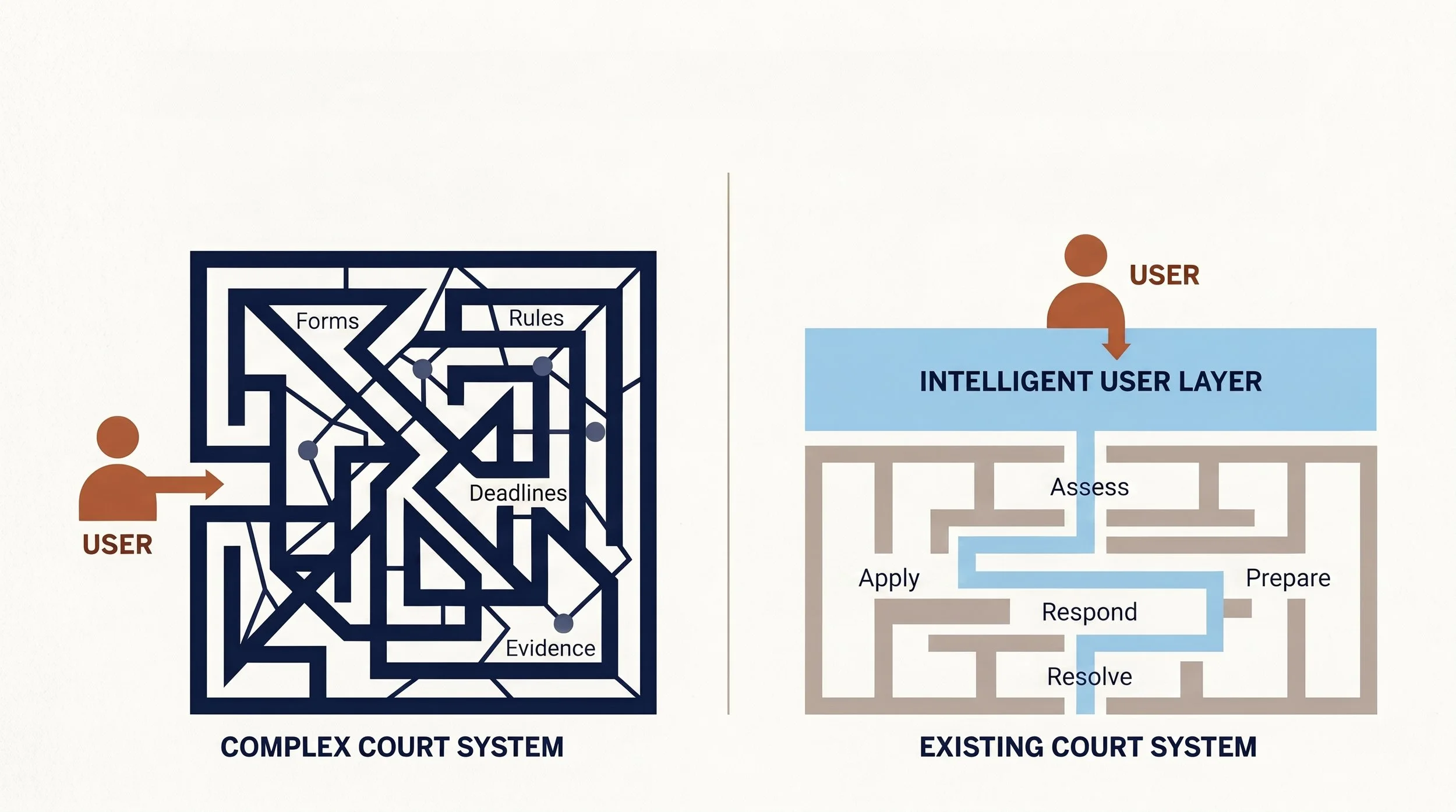
Build over the complexity. Build-not in the complexity.
The Fair Work Commission
Termination Help provides a useful example because the Fair Work Commission process already has a defined institutional architecture. There are statutory tests, prescribed forms, strict time limits, employer responses, conciliations, jurisdictional objections and, for some matters, hearings.
The first version of Termination Help works on the user side of that architecture. A dismissed worker provides information about what happened, and the service uses that information to assess the relevant pathway and prepare the material needed to commence an FWC claim.
Nothing about that requires the Commission to replace its case management system or redesign its forms. The innovation occurs before the information reaches the institution.
The more interesting possibility appears after filing. Once a claim has commenced, the user still needs to understand an employer’s response, prepare for conciliation, consider settlement documents and, in some cases, prepare for a hearing or obtain legal representation.
The proposed second version of Termination Help is designed around that whole journey. The same matter record can support assessment, application preparation, employer-response review, conciliation preparation, settlement support, hearing preparation and referral to a lawyer or community legal service.
That changes the unit around which the technology is designed. The unit is no longer a form, a court process or a piece of legal information; it is the user’s legal problem from beginning to end.
From representation to graduated assistance
This also challenges one of the assumptions built into much of the justice system. We tend to classify people as either represented or self-represented, even though those categories conceal a large range of possible forms of assistance.
Technology makes that range easier to provide. A person might begin with self-help, use guided navigation to identify a pathway, receive assistance preparing an application, use personalised procedural support during the proceeding and obtain targeted legal help when professional judgment or advocacy becomes necessary.
Full representation remains at the end of that continuum. It is no longer the only alternative to navigating the process alone.
This matters economically as well as practically. Having a lawyer perform every task associated with a dispute is an expensive way to provide assistance, particularly where the value of the claim is modest.
Some tasks require legal judgment, advocacy and professional responsibility. Others involve gathering facts, explaining process, organising evidence, tracking deadlines and preparing information in a form the institution can use.
Separating those functions creates the possibility of allocating scarce legal expertise differently. Lawyers can become involved where their expertise adds the most value, while technology supports some of the work that surrounds those moments.
Courts do not have to build everything
A user-side model also changes the role courts might play in legal technology. Courts need not necessarily design, procure and operate every application that helps people interact with them.
There is another role available: providing the infrastructure that allows others to build reliable services. Courts and governments could publish authoritative procedural information in machine-readable formats, maintain current digital forms and schemas, provide stable identifiers for procedural events and make appropriate interfaces available for filing and case-status information.
They could also create controlled environments in which new tools can be tested. Sandboxes, common data standards and clear assurance requirements could make innovation around courts safer without requiring courts to become software companies.
That would allow legal aid bodies, community legal centres, universities, law firms, technology companies and other organisations to develop different interfaces for different groups of users. Innovation could occur at the edges of the system while the core judicial infrastructure remained appropriately controlled.
There are precedents for thinking this way in other sectors. Governments do not need to build every application that uses public infrastructure; their role can include establishing standards, maintaining trusted systems and allowing others to build services on top of them.
Justice has particular requirements that make the analogy imperfect. But the distinction between public infrastructure and user-facing services is worth exploring.
The risks of a private layer around public justice
There is an obvious concern with this model. If privately developed technology becomes the interface through which people experience a public justice system, the quality and incentives of those services matter enormously.
A poorly designed tool could misstate a deadline, fail to identify a vulnerable user, steer someone towards an inappropriate pathway or give unjustified confidence in an incorrect answer. Commercial services could also create new inequalities if useful procedural assistance becomes available primarily to people who can pay for it.
Data raises another set of questions. A procedural navigator may hold an unusually detailed record of a person’s employment, family, financial circumstances, evidence and legal dispute, making privacy, security and secondary use of that information central design issues.
These concerns point towards governance rather than abandonment of the model. Certification, source requirements, auditability, privacy standards, escalation rules and clear boundaries around automated functions could all form part of an assurance framework for user-facing justice technology.
Public and non-profit versions should also be part of the ecosystem. The objective should not be to replace a difficult public system with an unregulated private one.
A more attractive model is public digital infrastructure supporting a plurality of trusted user-facing services. Courts maintain authority over justice; user-side tools make that justice easier to reach.
Simplification still matters
There is a danger in making complex systems easier to navigate. If technology becomes sufficiently good at shielding people from unnecessary complexity, the pressure to remove that complexity may diminish.
That would be the wrong outcome. A form that serves no useful purpose should not survive merely because AI can complete it, and an unnecessarily complicated process should not be preserved because software can guide people through it.
User-side innovation and institutional reform should therefore proceed together. One improves access to the system we have; the other improves the system itself.
Their timelines, however, are different. We can build useful tools around existing institutions considerably faster than we can rebuild the institutions themselves.
Start with the person
The current debate about AI and justice understandably spends a great deal of time looking at judges, courts and legal institutions. There is another place to look: at the person standing outside the system trying to work out what to do next
For many unrepresented people, the immediate problem is not that the court lacks artificial intelligence. It is that the court assumes a level of procedural knowledge they do not have
Technology can begin addressing that problem without waiting for the entire justice system to be redesigned. It can provide an intelligent layer between the person and the institution, translating rules, forms, deadlines and procedures into a pathway organised around the user’s circumstances
The long-term ambition should be simpler courts. The immediate opportunity is to make the courts we already have much easier for people to use
For access to justice, some of the most consequential applications of AI may therefore be built not inside the court, but immediately outside it.
