New tools shield litigants from the complexity of courts
When lawyers explain what they do, we tend to talk about law. We identify legal issues, interpret legislation, research cases, develop arguments and advise clients about their rights. But that is only part of what a lawyer does for someone involved in a legal dispute.
Lawyers also tell people what happens next.
They know which form needs to be filed, where it needs to go and when it is due. They know what evidence should be collected, what the other party is likely to file in response, what happens at a conciliation or directions hearing, and what needs to be prepared before the next stage
For a represented litigant, much of this happens almost invisibly. The lawyer absorbs the procedural complexity of the justice system and presents the client with a relatively simple series of decisions and actions.
For someone without a lawyer, the experience is very different. They encounter the system directly.
That distinction matters because access to justice is not only about understanding your legal rights. It is also about being able to do something with them.
The procedural capability gap
Courts and tribunals inevitably have procedures. Claims need to be defined. Evidence needs to be provided. Parties need an opportunity to respond. Deadlines need to exist. Decisions need to be made according to established rules.
The difficulty is that the resulting systems can be remarkably hard for an outsider to navigate.
A person might need to identify the correct jurisdiction, understand whether they satisfy a statutory test, select and complete the right form, comply with a filing deadline, identify relevant evidence and understand what happens after the application is lodged.
None of those tasks necessarily involves resolving the ultimate legal question. But getting one of them wrong can prevent that question from ever being properly considered.
This creates a procedural capability gap.
A person may have a legitimate claim and be perfectly capable of explaining what happened to them, but lack the institutional knowledge required to turn that experience into a properly constituted legal proceeding.
Lawyers traditionally bridge that gap.
The problem is that legal representation is expensive, and many of the disputes in which procedural assistance is most valuable are precisely those in which full legal representation is difficult to justify economically.
This suggests there are at least three different access problems:
access to law; access to legal advice; and access to legal process.
The internet has dramatically improved the first. Legal aid, community legal centres, pro bono services and private lawyers provide the second, although demand greatly exceeds available capacity.
The third deserves more attention.
From legal information to legal navigation
For the past two decades, one of the principal digital responses to unmet legal need has been to put more legal information online.
That has been enormously useful. Courts, tribunals, governments and legal assistance organisations now publish extensive information explaining legal rights and processes.
But information and navigation are different things.
A webpage might explain unfair dismissal law, identify the relevant legislation, provide a link to the Fair Work Commission and tell a reader that strict time limits apply.
A navigator can start somewhere else:
What happened to you?
From there, it can determine which questions need to be asked, identify the relevant pathway, explain what information is missing, identify the documents the person needs, calculate relevant dates and guide them towards the next procedural step.
The difference is subtle but important.
The first model asks the user to find information, understand it and work out how it applies to their circumstances.
The second begins with the user’s circumstances and uses them to determine what information and actions are relevant.
That moves digital legal assistance from publishing information towards supporting action.
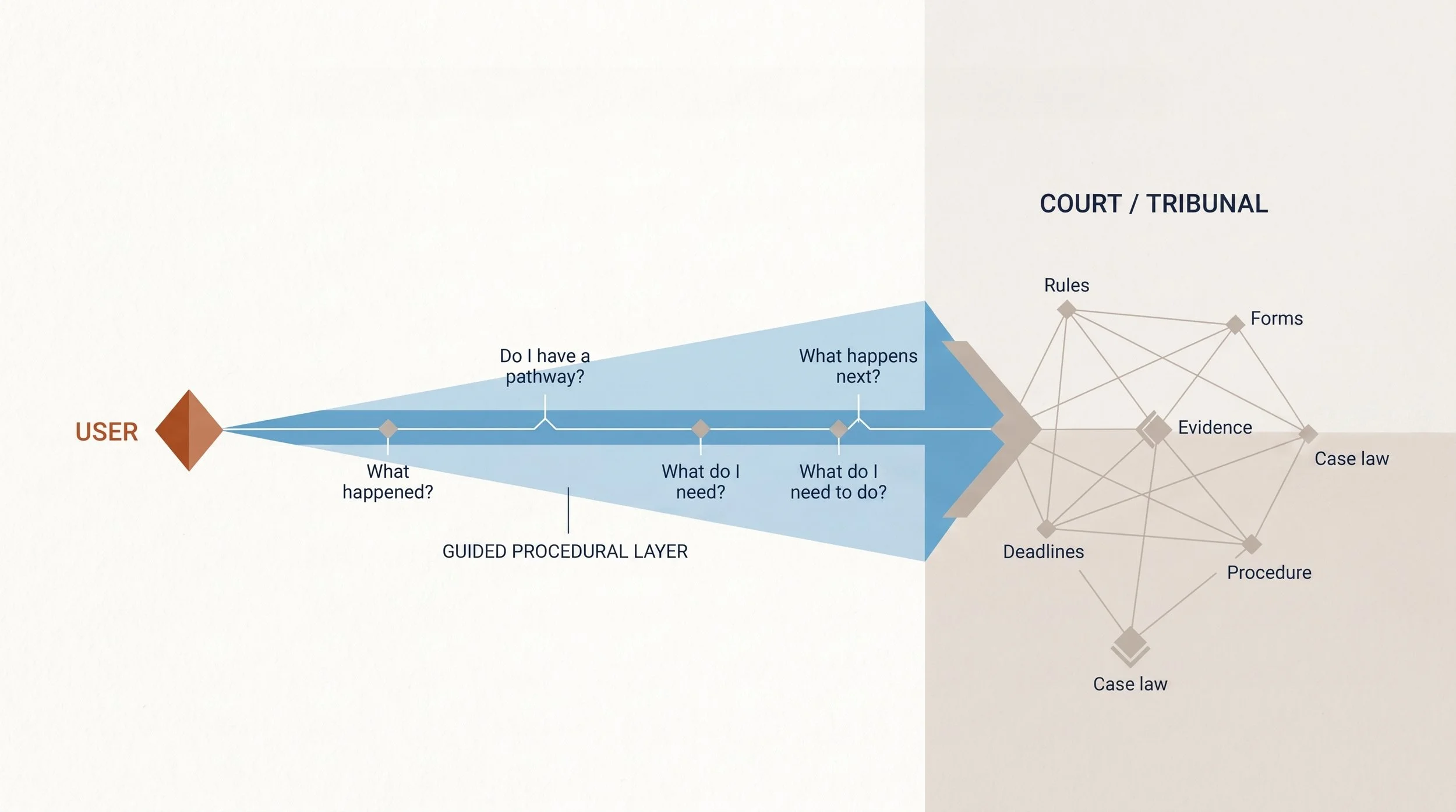
Lighting the path for unrepresented litigants.
A new generation of procedural tools
Guided legal tools are not entirely new. Rule-based expert systems and document automation have existed for decades. What is changing is the range of tasks that can potentially be brought together in a single interaction.
Large language models are particularly good at communicating in ordinary language and extracting structured information from unstructured accounts. Used carefully, they can sit alongside deterministic rules, authoritative legal sources, forms and procedural information.
The result does not have to resemble a general-purpose chatbot.
A better model is a constrained system in which conversational technology provides the interface, while legislation, case law, procedural rules, official forms and carefully designed decision logic provide the architecture underneath.
That architecture can potentially combine:
the user’s facts + the applicable rules + procedural requirements + evidence + forms + deadlines + the current stage of the proceeding.
The objective is not to have AI decide the dispute. It is to help the person navigate it.
Termination Help: from an employment problem to a filing-ready claim
Termination Help is one example of this approach being developed in Australia.
The service starts with something a person understands: I have lost my job.
The user answers questions about what happened and their employment circumstances. The system uses those answers to identify relevant issues and guide the user through the requirements of an application to the Fair Work Commission
For users who purchase the preparation service, the objective is not simply to provide information about unfair dismissal. It is to produce the forms and supporting material required to commence the relevant process.
The distinction matters.
A conventional information service might explain that an unfair dismissal application ordinarily needs to be made within 21 days, describe the eligibility requirements and provide a link to the relevant FWC form.
A guided pathway can know when the user’s employment ended, identify the deadline that applies to that person, ask the questions required to prepare the application, identify gaps in the factual account and assemble the resulting information into the documents they need.
The information is no longer generic. It is organised around the individual matter.
The next stage of development extends that idea beyond commencement of the claim.
An employment dispute does not stop when an application is filed. An employer responds. Jurisdictional objections may be raised. A conciliation is scheduled. Evidence may need to be organised. Settlement terms may be proposed. Some matters proceed to hearing.
A procedural navigator can potentially remain with the user through those stages: reviewing an employer response against the account already provided, identifying new factual disputes, helping the person prepare for conciliation, explaining settlement documents, preparing materials for later stages and recognising when the matter should be handed to a lawyer.
The important design choice is that the technology follows the person’s dispute, rather than requiring the person to repeatedly work out how each component of the institution operates. That is the premise of the proposed second-generation Termination Help pathway.
This model already exists in other forms
There are useful precedents overseas.
Upsolve has developed guided tools for people dealing with debt and bankruptcy in the United States. Its bankruptcy service takes users through an eligibility and information-gathering process and helps generate the forms required for a Chapter 7 bankruptcy filing.
In England and Wales, CourtNav helps people seeking certain injunctions relating to domestic abuse. Rather than simply presenting information about injunctions, it guides users through questions about their circumstances and helps produce the documents required for the court application.
The jurisdictions, legal problems and technologies differ. The common design principle is more interesting than the individual products.
They begin with the person and their problem, not with a library of legal information.
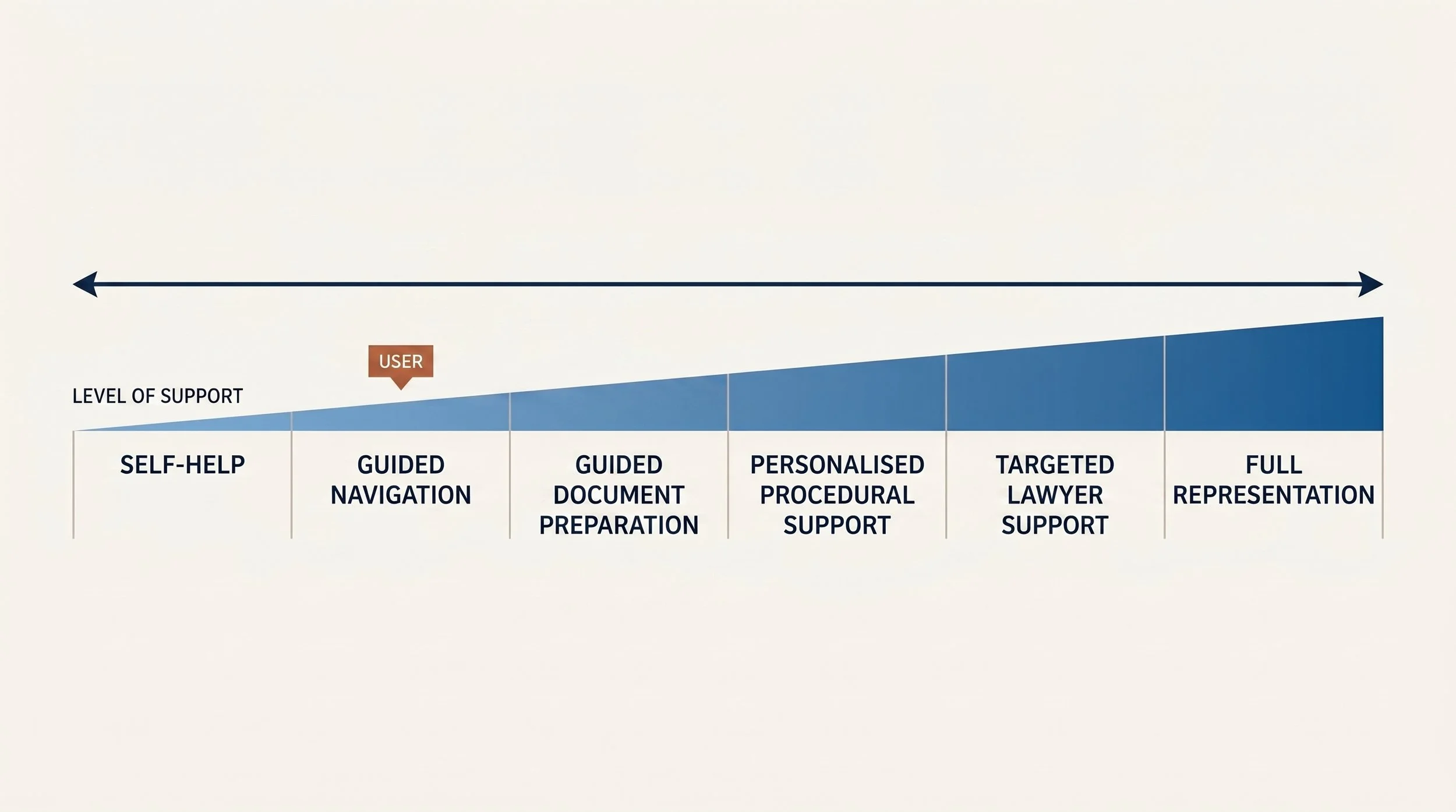
Legal support is not binary. Along the emerging legal support spectrum, technology dominates.
The space between self-help and a lawyer
This points towards a broader change in the way we think about legal assistance.
We commonly divide people involved in legal proceedings into two groups: represented and unrepresented. In practice, there is an enormous space between those categories.
A person might need simple information at one stage, guided navigation at another, help preparing documents later, personalised procedural support before a conciliation and a lawyer for one particularly difficult part of the case.
Technology makes those intermediate forms of assistance much easier to construct.
The result could be a continuum:
self-help → guided navigation → guided document preparation → personalised procedural support → targeted lawyer support → full representation.
A person need not remain at one point on that continuum. The appropriate level of support can change as the matter progresses.
This matters for access to justice because full legal representation is an extraordinarily expensive way of supplying procedural assistance.
There will always be matters in which a lawyer’s judgment, advocacy and professional responsibility are indispensable. But it does not follow that every procedural task performed by a lawyer requires a lawyer.
Separating those functions creates the possibility of providing much more assistance at much lower cost.
The risks are real
There are good reasons to approach this carefully. Procedural information changes. Forms are updated. A seemingly straightforward matter can contain a legal issue that changes the appropriate pathway. A confident but incorrect answer from an AI system can be more dangerous than an obviously incomplete webpage.
There are also important questions about privacy, security, accessibility, vulnerability, the boundary between legal information and legal advice, and responsibility when a system gets something wrong.
Good design therefore matters enormously.
A procedural navigator should be grounded in authoritative sources, distinguish between tasks that can safely be automated and those requiring professional judgment, identify uncertainty rather than conceal it, and provide clear routes to human assistance when a matter moves beyond its competence.
But the risks also need an appropriate comparator.
For many people, the alternative is not comprehensive advice from an experienced lawyer.
It is navigating the process alone.
They may be working from court websites, forms, internet searches and increasingly a general-purpose AI system that knows nothing about the procedural state of their particular matter.
A properly designed procedural tool should be assessed against that reality.
Making the path visible
There is an understandable tendency to think about access-to-justice technology in terms of making courts themselves simpler….We should!
Unnecessary procedural complexity should be removed rather than preserved indefinitely behind increasingly sophisticated interfaces.
But institutional reform takes time. Meanwhile, people continue to encounter legal systems that were largely designed on the assumption that lawyers would help them navigate them.
There is now another possibility.
We can build tools that absorb some of that complexity in much the same way lawyers have traditionally done: understanding where a person is in a process, identifying what matters now, and illuminating the next part of the path. That raises a further question.
If we can improve the user’s experience without first rebuilding the court, where should access-to-justice innovation begin?
That might just be the subject of my next post…
