Public Interest Tech, Part 3
Funders need to become market designers
Government and philanthropy do more than finance public interest technology. Through what they fund, procure and require, they shape the market in which it develops.
Every grant creates incentives.
If funders pay organisations to create bespoke applications, organisations will create bespoke applications. If funding rewards interoperability, reuse and shared infrastructure, the market will begin to organise around those things instead.
The fragmentation of public interest technology is therefore not simply a failure of coordination among nonprofits. It is partly the predictable result of the incentives created by funding systems.
Why conventional grant-making produces fragmentation
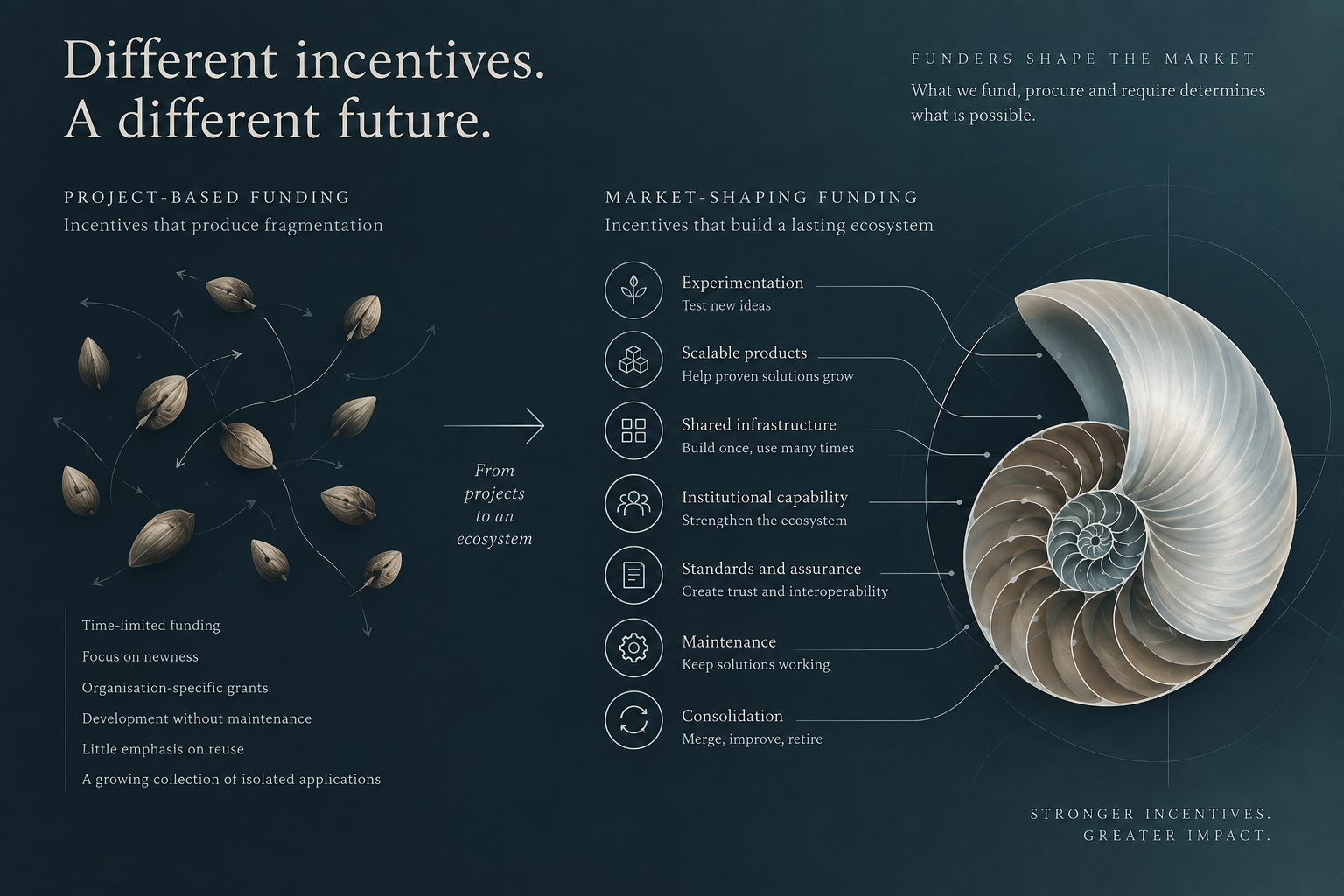
Conventional grant-making is generally organised around projects:
funding is time limited;
applications describe defined activities and outputs;
innovation and novelty are often valued;
grants are made to individual organisations;
development is funded more readily than maintenance; and
visible products are easier to fund than shared infrastructure.
These structures work poorly for technology.
They encourage organisations to propose new applications rather than maintain or extend existing ones. They can finance development without financing the operating costs created by successful deployment. They reward visible launches more readily than standards, APIs, integration or maintenance.
Organisations respond rationally to those incentives.
If funding is available to build something new but not to maintain or improve something that already exists, the predictable result is an expanding collection of applications with uncertain futures.
Stop paying repeatedly for the same thing
Scarce public and philanthropic funding should not repeatedly finance substantially identical technical capabilities.
Before funding a new product, funders should ask:
What already exists?
Can an existing product or platform be extended?
What components can be reused?
Is there a genuine reason to build something new?
If the project succeeds, who will operate and finance it?
Could the investment create infrastructure that other organisations can use?
This does not require eliminating experimentation. Competing approaches can be valuable, particularly where the technology or service model remains uncertain.
But duplication should be intentional rather than accidental.
A mature funding system would distinguish between useful experimentation and repeatedly paying to solve the same technical problem.
Procurement is a policy instrument
Government procurement has even greater capacity to shape the market.
Procurement requirements can establish expectations concerning:
interoperability;
open standards;
accessibility;
data portability;
security and assurance;
independent testing;
complex-user pathways;
data rights;
APIs and integration; and
vendor exit and continuity arrangements.
These requirements can influence the development of products well beyond an individual government contract.
Procurement can also address the risk of cream-skimming. If technology providers have commercial incentives to serve only straightforward users, government contracts can require accessibility, assisted pathways and functionality for users with more complex needs.
Government is therefore not merely purchasing software. It is helping determine what kinds of technology businesses are viable.
Used deliberately, procurement can create a market for responsible public interest technology.
Fund the boring things
Some of the most important technology investments produce little that can be launched publicly.
A functioning technology ecosystem needs funding for:
maintenance;
cybersecurity;
integration;
data migration;
documentation;
APIs;
standards;
testing and assurance;
product management;
user support; and
independent evaluation.
These activities are less visible than launching a new application. They are also essential to whether technology continues to work.
Funding systems designed around innovation can systematically underinvest in them. The result is predictable: more products are created than the ecosystem can responsibly maintain.
A serious public interest technology strategy therefore needs to fund the boring things.
Fund consolidation
Sometimes the responsible funding decision will be not to fund another product.
Mature technology markets consolidate. Stronger products acquire users, weaker products close, overlapping systems merge and useful components are incorporated into larger platforms.
Funders could support:
migration from weaker systems to stronger ones;
consolidation of overlapping products;
acquisition and reuse of valuable intellectual property;
integration of useful components into shared platforms; and
retirement of technology that no longer justifies continued investment.
Public interest technology should not be exempt from this process simply because the original products were created with philanthropic or public money.
An effective ecosystem requires mechanisms for stopping things as well as starting them.
Public money should create public value
Public or philanthropic funding of technology does not necessarily require public or nonprofit ownership.
It should, however, produce durable public value.
Depending on the project, funding arrangements might secure:
reuse rights;
affordable sector licences;
open standards;
data portability;
public or sector-accessible APIs;
interoperability requirements;
continuity arrangements if a provider fails;
protections following acquisition or change of control; and
rights that allow socially valuable technology to survive the original project.
In some circumstances, open-source technology will be appropriate. In others, proprietary technology may provide the strongest path to sustainability and scale.
The relevant question is not whether the public owns the software. It is whether public investment produces public value that survives the original grant or contract.
Pay for outcomes, not applications
Technology funding also requires a better unit of measurement.
Rather than asking whether an application was delivered, funders should ask:
Did more people receive assistance?
Did the quality of that assistance improve?
Did the cost of serving each user fall?
Did the intervention improve outcomes?
Did it reduce pressure elsewhere in the system?
Can the technology reach substantially more people without costs rising proportionately?
Did the investment create capability that others can reuse?
Is the product still operating and improving several years later?
These measures shift attention from technological outputs to social and institutional outcomes.
They also create stronger incentives for reuse. Extending an existing platform may produce substantially greater social value than creating a new one, even though it generates less visible innovation.
A portfolio for public interest technology
A sophisticated funding strategy would treat public interest technology as a portfolio rather than a collection of projects.
That portfolio might include investment in:
Experimentation — testing genuinely new technologies and service models.
Scalable products — helping successful interventions move from pilot to sustained operation.
Shared infrastructure — platforms, APIs, data infrastructure and reusable components.
Institutional capability — product, technology, procurement and implementation expertise.
Standards and assurance — interoperability, testing, evaluation, safety and governance.
Maintenance — keeping successful technology secure, current and useful.
Consolidation — merging, migrating or retiring products where appropriate.
These investments perform different functions and require different measures of success.
Not every technology dollar should be an innovation dollar.
From grantmaker to market steward
Funders have more influence over the structure of public interest technology than they sometimes recognise.
Government, philanthropy and major institutional funders determine which activities are economically viable. Their decisions influence whether organisations collaborate or compete, whether technology is reused or rebuilt, whether infrastructure develops and whether successful products have a path from pilot to scale.
They can continue financing a collection of disconnected technology projects. Or they can deliberately help construct the market in which public interest technology operates.
That requires a broader conception of the funder’s role: not simply selecting good projects, but creating the conditions in which good technology can survive, spread and improve.
The shift is from grantmaker to market steward.
