Public Interest Tech, Part 2:
Build institutions, not projects
The challenge facing public interest technology is increasingly not access to technology. Powerful digital infrastructure, software and AI capabilities are becoming cheaper and more widely available. The scarcer resources are the institutional capabilities required to deploy them well.
This changes the nature of the problem. The question is not simply whether civil society organisations can acquire better technology. It is where the capabilities required to build, govern, maintain and improve that technology should sit.
The institutional capability gap
Technology adoption requires more than technical expertise. Organisations need capability in:
product ownership and management;
technology procurement and implementation;
data governance;
cybersecurity and risk;
AI governance and assurance;
evaluation and testing; and
organisational change.
These capabilities remain relatively thin across much of civil society.
That does not mean every organisation needs an engineering team, AI specialists or product managers. Attempting to replicate these capabilities across thousands of relatively small organisations would itself be inefficient.
Every organisation increasingly needs sufficient technological literacy to understand its needs, risks and options. Far fewer need the institutional capability to build and operate technology themselves.
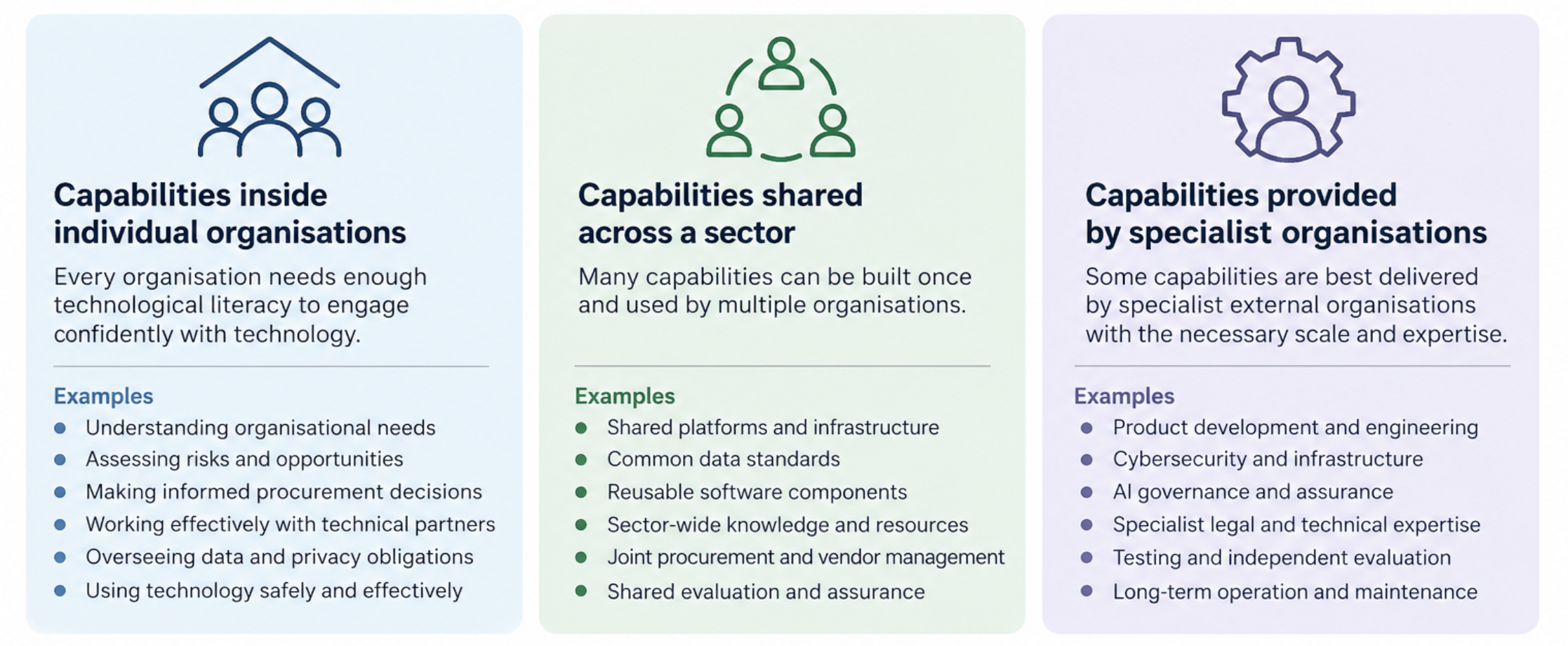
A better model distinguishes between:
capabilities that need to exist inside individual organisations;
capabilities that can be shared across a sector; and
capabilities best provided by specialist external organisations.
The fragmentation problem
Civil society is institutionally fragmented. Thousands of organisations address overlapping problems, often with separate funding, governance, technology and data systems.
That fragmentation has advantages. Local organisations understand their communities, specialist organisations develop deep expertise, and institutional diversity can support experimentation and independence.
But the same structure becomes inefficient when every organisation separately procures and develops technology.
Across legal assistance, homelessness, health, migration and other public interest fields, organisations repeatedly need versions of the same underlying capabilities:
intake;
triage;
eligibility assessment;
referral;
document and evidence collection;
case management;
reporting;
knowledge management; and
increasingly, AI-assisted information and decision support.
There is little reason for each organisation to build these capabilities independently.
A service system designed around human-delivered services does not automatically provide an efficient architecture for digital services.
Shared infrastructure
The alternative is not centralisation of civil society. It is greater investment in shared infrastructure.
Some capabilities can be built once and used repeatedly:
identity and authentication;
common data standards;
APIs;
secure hosting;
reusable software components;
knowledge libraries;
AI assurance frameworks;
testing environments;
procurement expertise; and
independent evaluation.
Shared infrastructure changes the economics of technology adoption. Development costs can be spread across many organisations, while improvements made for one user can benefit others.
This produces increasing returns across the ecosystem. Each additional organisation does not need to recreate the underlying infrastructure before it can innovate.
Data is infrastructure
Civil society collectively generates substantial information about social problems, service demand, user journeys and institutional outcomes. Much of that information remains fragmented across incompatible systems, stored in unstructured formats or collected according to different definitions.
AI increases both the potential value of this information and the cost of fragmentation.
Common data standards can support:
interoperability between organisations and systems;
more effective referral;
sector-wide analysis of demand;
evaluation and comparison of interventions;
better research and service design; and
development of technology that can operate across institutional boundaries.
Standards are therefore not simply an administrative exercise. They are infrastructure.
Build once, adapt many times
Many public interest problems differ substantially in their substantive content while sharing similar underlying processes.
Employment, tenancy, debt and discrimination disputes may involve different laws and decision rules, for example, while requiring similar capabilities for:
intake;
eligibility and jurisdiction assessment;
issue identification;
evidence collection;
information and guidance;
document generation;
referral; and
escalation to human assistance.
Technology designed around reusable architecture can therefore be adapted rather than rebuilt.
Before financing another application, funders should ask:
Does the underlying capability already exist?
Can an existing product or platform be extended?
Which components could be reused elsewhere?
Is the proposed architecture designed for future adaptation?
The objective should increasingly be to configure rather than recreate.
Partnerships need to become structural
Civil society has long relied on partnerships with business, universities and professional services firms. In technology, however, those partnerships are often organised around individual projects.
A more mature ecosystem requires structural relationships and a clearer allocation of institutional roles:
Civil society organisations community knowledge, subject-matter expertise, user representation and legitimacy.
Technology companies engineering, infrastructure, platforms and specialist technical capability.
Professional services firms legal, commercial, implementation and governance expertise.
Universities research, evaluation and evidence.
Government standards, procurement, infrastructure and market creation.
Specialist public interest technology organisations product development, translation between sectors, reusable technology and long-term operation.
The important question is not who can contribute to a project. It is which institution should permanently perform each function.
Governance without technological isolation
Shared infrastructure inevitably raises questions about independence, particularly for organisations working with vulnerable communities or challenging government and corporate power.
Those concerns are legitimate. They do not require technological self-sufficiency.
Independence can instead be protected through:
governance;
contractual rights;
control over data;
technical standards;
portability and interoperability;
vendor diversity; and
clear institutional accountability.
Organisations can retain control over their services and advocacy while sharing underlying technical infrastructure.
The objective should be interoperability without institutional homogenisation.
What the ecosystem might look like
A functioning public interest technology ecosystem might therefore have several layers:
Frontline organisations
Community relationships, service delivery, expertise and advocacy.
Shared platforms and specialist providers
Reusable products, product management, engineering and implementation.
Infrastructure and assurance
Data standards, APIs, testing environments, cybersecurity, evaluation and AI assurance.
Funders and government
Capital, procurement, standards, incentives and market stewardship.
Not every organisation needs to become a technology organisation in order to benefit from technology.
If digital transformation requires every nonprofit to independently acquire engineering, product, cybersecurity, data and AI capability, transformation will remain slow, expensive and uneven.
The unit of investment should therefore begin to shift: from individual projects towards the institutional infrastructure that makes many projects possible.
