Public Interest Tech, Part 1: Scale requires an economic engine
Public interest technology often begins in a familiar way. An organisation identifies an important social problem, secures a grant, commissions a platform, launches a pilot and demonstrates that the idea works.
Then the grant ends. The organisation discovers that the technology needs continuing maintenance, hosting, security updates, user support and product development, while the next funding round is intended to support something new.
The problem is rarely a lack of commitment to the mission. It is that the financial model received much less attention than the social problem and the technology designed to address it.
Designing a financial model
Michael Porter and Mark Kramer argued in their work on Creating Shared Value that economic and social value need not be opposing objectives. Some of the most scalable responses to social problems can be created when solving the problem also generates the economic value required to sustain the solution.
That idea has particular relevance to public interest technology. A digital product capable of helping 100,000 people is not necessarily more sustainable than a face-to-face service helping 1,000 if nobody has worked out how the digital product will still be operating five years later.
A financial model is therefore not something to add after proving that the technology works. If the objective is sustainability and scalability, it is part of the original design problem.
Most nonprofits are not technology companies
Civil society organisations bring capabilities that technology developers frequently lack. They understand communities, vulnerability, service delivery and the practical consequences when public systems fail.
Those capabilities do not automatically make an organisation well placed to build and operate a technology product. Product management, engineering, UX design, cybersecurity, testing, deployment, data governance and continuous development are specialist institutional capabilities.
Building the first version is only the beginning. Someone then has to maintain the product, respond to changes in law and policy, manage vendors and infrastructure, fix problems, support users and decide what gets built next.
Commercialisation presents another set of challenges. Pricing, distribution, customer acquisition, licensing, contracting and procurement are not generally core capabilities of a community legal centre, homelessness service or human rights organisation.
There is nothing surprising about this. We would not expect a software company to become an expert homelessness provider because it has good engineers, and we should not assume that expertise in homelessness makes an organisation the natural operator of a software business.
The grant-funded prototype trap
Philanthropy and government funding often support projects. Technology needs products.
A grant can fund discovery, design, development and a pilot. A successful pilot then creates a continuing obligation to pay for cloud infrastructure, software licences, model and API costs, security, maintenance, technical support and further development.
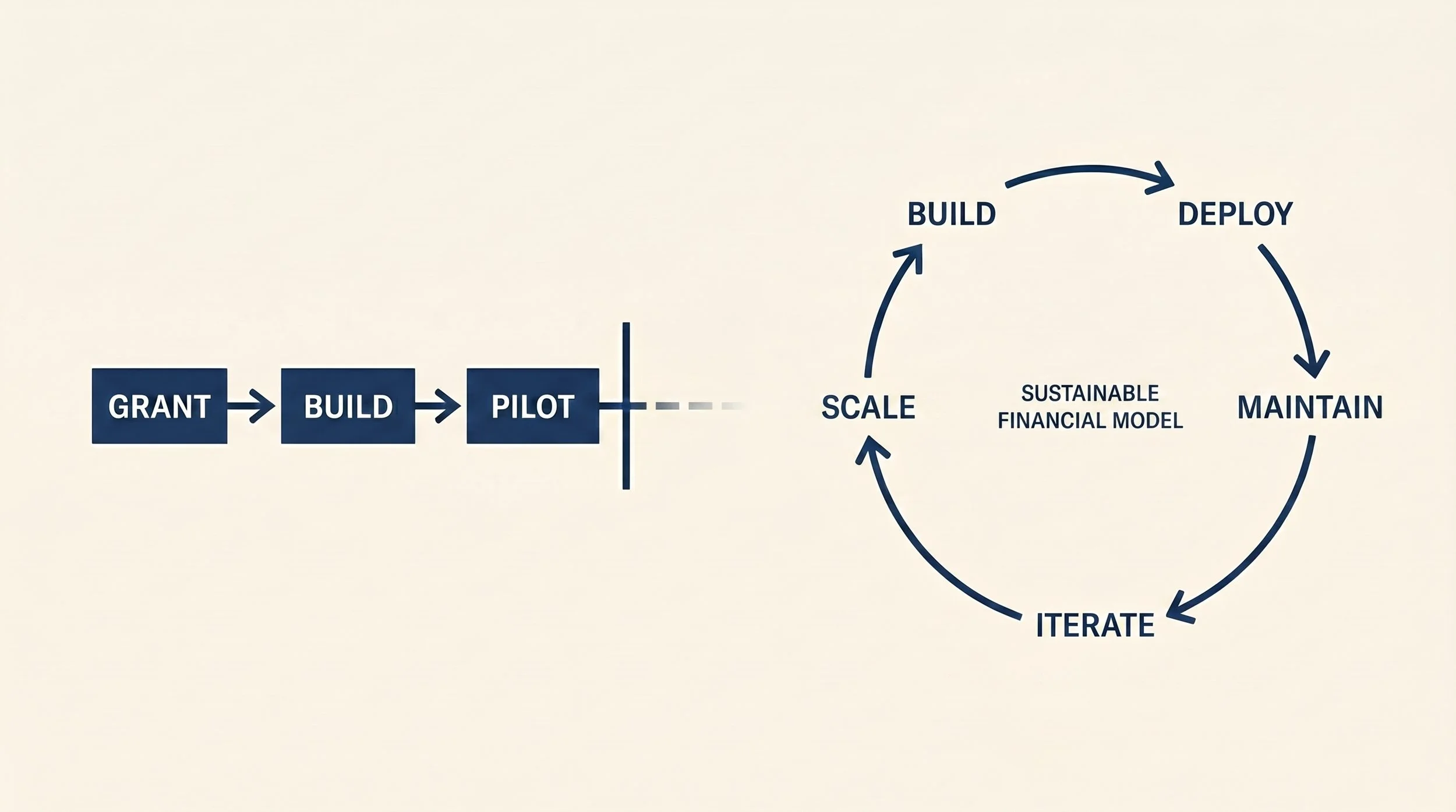
The better the product performs, the larger some of those costs may become. A platform built with a $500,000 grant can leave its owner with a substantial annual funding requirement precisely because the original investment succeeded.
This should change the questions asked at the beginning of a technology grant. It is not enough to ask whether the proposed tool will be useful and whether the applicant can build it.
Funders should also ask who will operate it, who will pay for it, who will own it and what happens when the grant ends. A particularly useful test might be: if this works, what institution and financial model will still be supporting it in ten years?
Start with the missing middle
There is another tension between conventional social-sector service design and technology product development. Civil society organisations quite properly tend to focus their resources on people experiencing the greatest disadvantage and the most complex needs.
Technology products are often developed differently. An MVP usually starts with a sufficiently common and tractable problem, establishes that the core product works, and then expands its functionality as the product matures.
In access to justice, that approach points towards the large missing middle. These are people who are unlikely to qualify for free legal assistance, cannot sensibly pay thousands of dollars for conventional legal services, but have legal problems sufficiently structured to be assisted by technology.
A dismissed worker with a relatively conventional unfair dismissal claim is one example. Their problem may not require a lawyer to perform every task, but the existing alternatives can still be difficult to navigate without help.
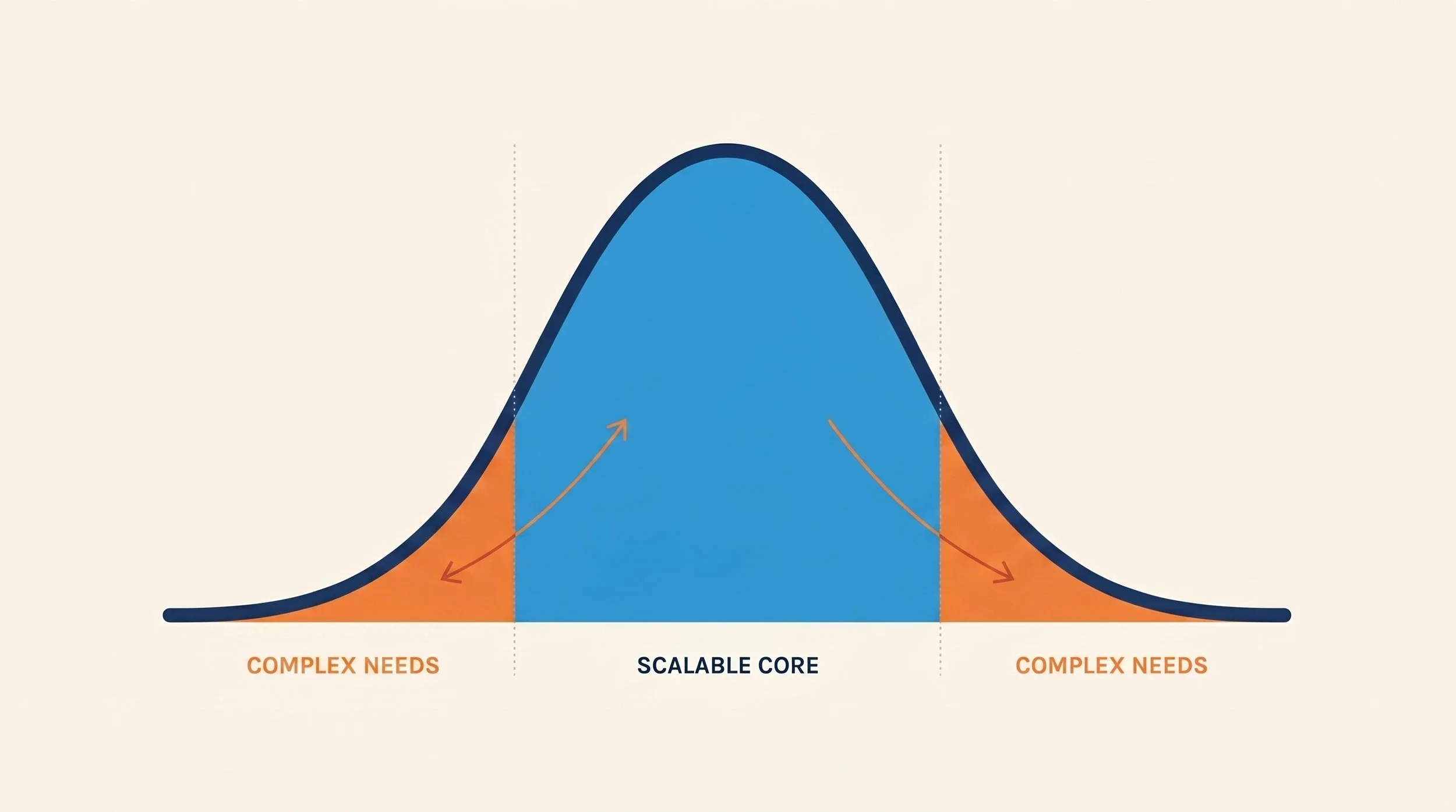
Building for this group first does not mean deciding that people with more complex needs matter less. It can provide a stable product, a large user base and an economic foundation from which more difficult functionality can be developed.
The centre can help finance the edges
This creates an important possibility for public interest technology. Revenue generated by serving relatively standard needs at scale can help finance the development required to serve people whose circumstances are more complicated.
A product might initially handle the majority of users through an automated pathway. Over time it can add languages, accessibility features, specialist pathways, human assistance and functionality for circumstances that cannot safely be addressed by the original product.
In that model, commercial sustainability can support inclusion. The centre of the distribution helps finance the work required to reach its edges.
But this outcome will not occur automatically. In fact, ordinary commercial incentives can point in precisely the opposite direction.
If 80 per cent of users can be served cheaply while the remaining 20 per cent require expensive development or human support, a profit-maximising provider has an obvious incentive to concentrate on the 80 per cent. Governments and nonprofits can then be left with the people whose needs are most complex and most expensive to meet.
Public interest technology could therefore create a new form of cream-skimming. Private providers automate the straightforward and profitable demand while the cost of complexity remains with the public and nonprofit sectors.
Design the economics around the social purpose
The answer is not to choose between commercialisation and social purpose. It is to design financial arrangements in which the commercial incentives support the outcome we are trying to achieve.
One useful starting point is to separate the user, beneficiary and payer. In public interest services, they are often not the same person.
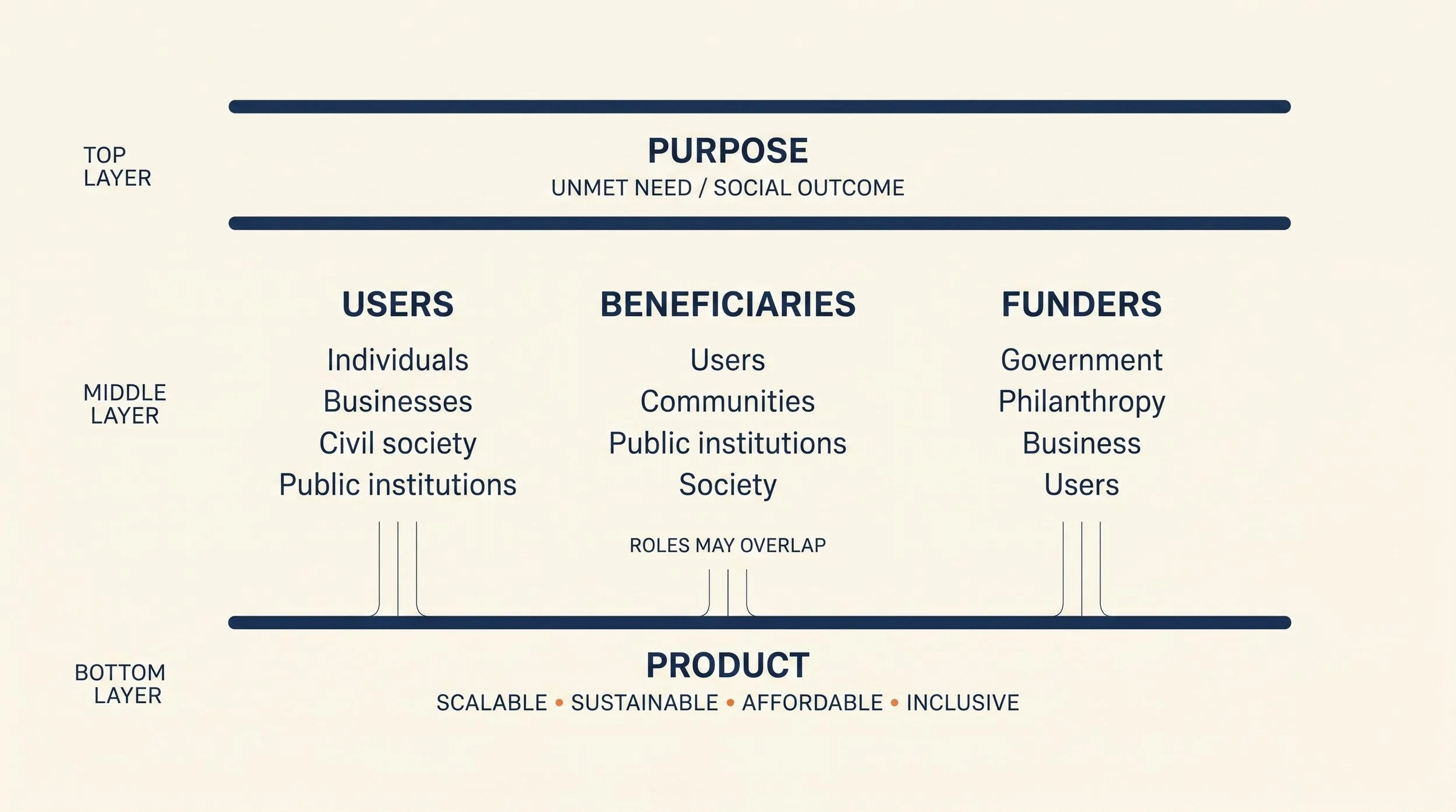
A worker might use an employment law tool, for example, but better-prepared claims can also benefit tribunals, employers, legal assistance organisations and government. Any one or a combination of those actors could potentially contribute to the cost of providing the service.
That creates considerably more possibilities than either charging the vulnerable user or obtaining another grant. Institutional subscriptions, government procurement, cross-subsidy, licensing, transaction fees, philanthropic underwriting and partnerships with professional service firms can all form part of a sustainable model.
The model can also contain explicit incentives to reach harder cases. Procurement can require accessibility and complex-user pathways, philanthropy can subsidise development of socially important but commercially unattractive functionality, and mainstream revenue can cross-subsidise assisted services.
The financial architecture can, in other words, encode some of the social purpose.
Should nonprofits own the technology?
There is an assumption in some public interest technology projects that the organisation identifying the problem should also build and own the solution. That deserves to be questioned.
A purpose-driven company may sometimes be a better home for a scalable technology product. So might a joint venture between business and civil society, a sector-owned technology organisation or a specialist public interest technology provider.
The nonprofit can still play an essential role. Its expertise may be most valuable in defining the problem, representing user interests, establishing safeguards, testing the product and holding its operators accountable.
Ownership also deserves more attention from funders. If philanthropic money creates a valuable technology asset, neither automatically transferring that asset to the grant recipient nor leaving all intellectual property with a commercial developer necessarily maximises its long-term social value.
Different arrangements are possible. Sector ownership, mission-locked corporate structures, open-source components, perpetual affordable-use licences and contractual rights that survive the failure or acquisition of a vendor can all protect the original purpose without requiring every technology asset to be owned by a nonprofit.
The objective should be durable mission alignment rather than adherence to a particular corporate form.
Fund the ecosystem, not another app
These questions become more important as government and philanthropic resources tighten. Scarce funding should increase the pressure to build infrastructure that can be reused rather than repeatedly financing isolated technology projects.
Some funding could support organisations with serious engineering, product and commercialisation capability whose purpose is to serve civil society. Others could own and maintain scalable technology and license it affordably across hundreds of organisations.
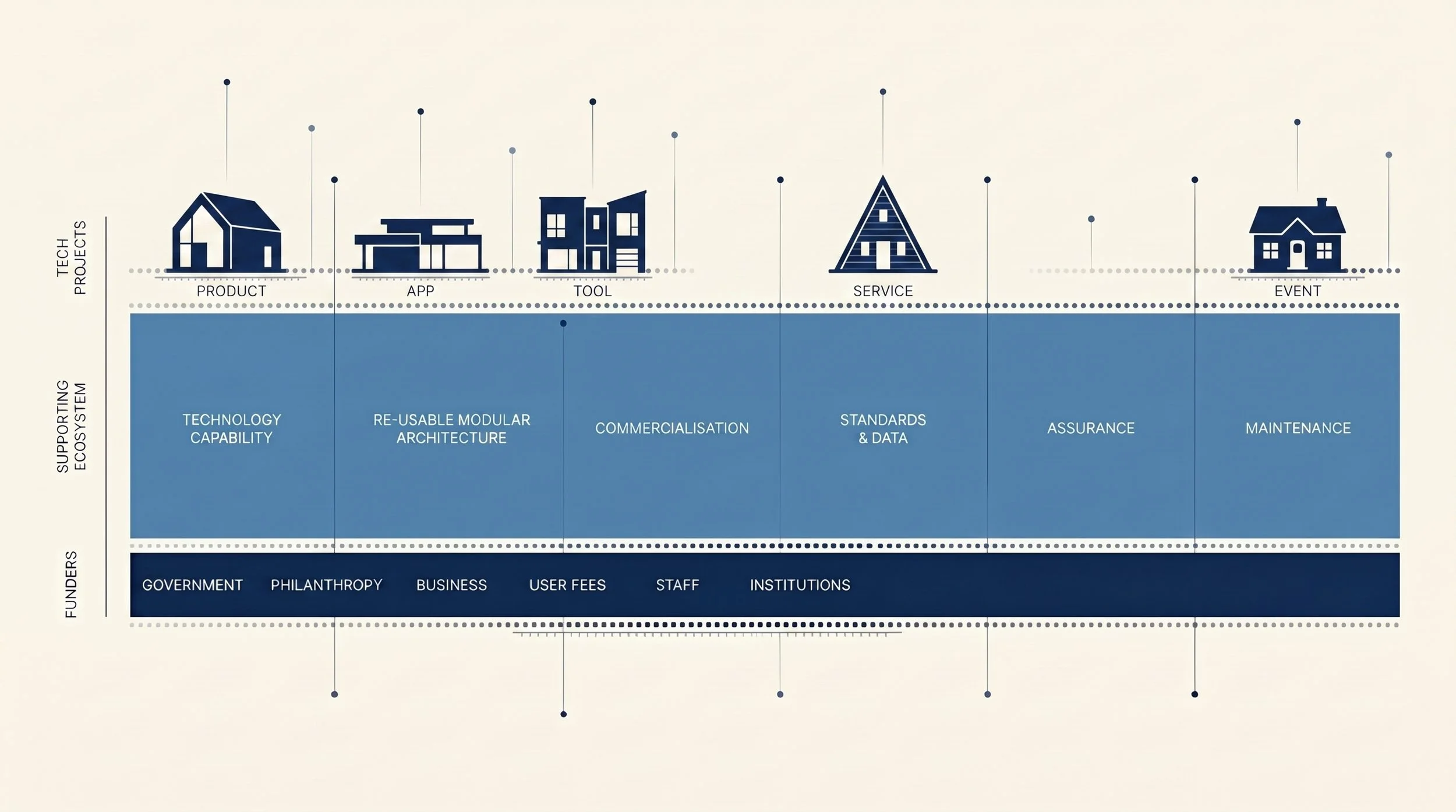
Funders should ask whether a dollar invested in a particular application would create more social value if some of it were invested in reusable capability that lowers the cost of the next ten applications.
There is also a need for shared infrastructure that individual nonprofits have little reason or capacity to build themselves. Common data standards, APIs, assurance frameworks, procurement expertise, testing environments, reusable software components and independent evaluation could reduce the cost of technology adoption across the sector.
This requires a different understanding of philanthropic leverage. The highest-impact technology grant may not produce an application that a funder can launch and point to twelve months later.
It might instead establish the capability that allows 200 organisations to use technology they could never afford to build or maintain themselves. That is less visible than another bespoke platform, but potentially much more valuable.
A different test for public interest technology
Social purpose should remain the starting point for public interest technology. The question is whether our current approaches to funding and institutional design give good ideas a realistic chance of achieving their intended scale.
A serious proposal for a technology intervention should therefore be able to answer more than whether it solves an important problem. It should explain how it can scale, who will pay if it succeeds, who will maintain it and whether its economic incentives encourage its operator to reach people who are difficult and expensive to serve.
This requires some uncomfortable conversations about revenue, pricing, ownership and commercialisation in parts of civil society where those ideas can sit uneasily with organisational culture. Avoiding those conversations does not remove the economics; it simply leaves the financial model to chance.
Purpose-driven for-profit organisations will sometimes be the right vehicle. Nonprofits, governments, partnerships and shared sector infrastructure will be better in other circumstances.
The important distinction is not between organisations that make money and organisations that do good. It is between solutions with an economic model capable of sustaining their social value and those that depend indefinitely on finding the next grant.
Public interest technology gives us an opportunity to build services that reach far more people at dramatically lower marginal cost. Realising that opportunity will require us to devote as much imagination to the institutions, incentives and financial models behind those services as we devote to the technology itself.
The financial model is not something that sits behind the solution. It is part of the solution.
